







// Guide
How to Use AI for Sports Betting (Without Letting It Bet for You)
A practical guide to using AI for sports betting: what ChatGPT, Claude, Gemini and Grok do well and badly, a five-step research workflow, prompts you can copy, and how to keep the AI from making your decisions for you.
Can AI help with sports betting? Yes, but probably not in the way the ads suggest. A chatbot will not tell you who wins on Sunday. What it can do is speed up the research, check your arithmetic, build a simple model and keep you honest about your record. Used that way, AI is a genuinely useful betting assistant. Used as an oracle, it is an expensive way to lose money faster.
This guide shows how to use AI for sports betting step by step: what general assistants such as ChatGPT, Claude, Gemini and Grok do well and badly, a research workflow you can follow, prompts you can copy, and where specialist tools do the job better.
Can AI help with sports betting? The short answer
AI helps most with the work around a bet, and least with the bet itself. The most rigorous public test makes the point. In April 2026 the AI lab General Reasoning published KellyBench, which gave 12 leading AI models a simulated £100,000 bankroll to bet through the 2023-24 Premier League season. Every one lost money on average. The authors found that the models often failed to act on their own analysis or adapt as the season changed.
So treat AI as a fast, tireless research assistant that you must fact-check, not as a tipster.
What AI does well, and where it fails
| Good at | Bad at |
|---|---|
| Summarising team news, previews and statistics you give it | Knowing today’s injuries or line-ups without web search |
| Converting odds and calculating implied probability and expected value | Seeing live odds at your sportsbook |
| Explaining concepts such as expected goals, EPA or closing line value | Admitting it does not know: it can state wrong facts confidently |
| Writing spreadsheet formulas or Python code for a simple model | Beating efficient markets such as NFL spreads on its own |
| Reviewing your betting log for patterns and leaks | Staying consistent over a long season, as KellyBench showed |
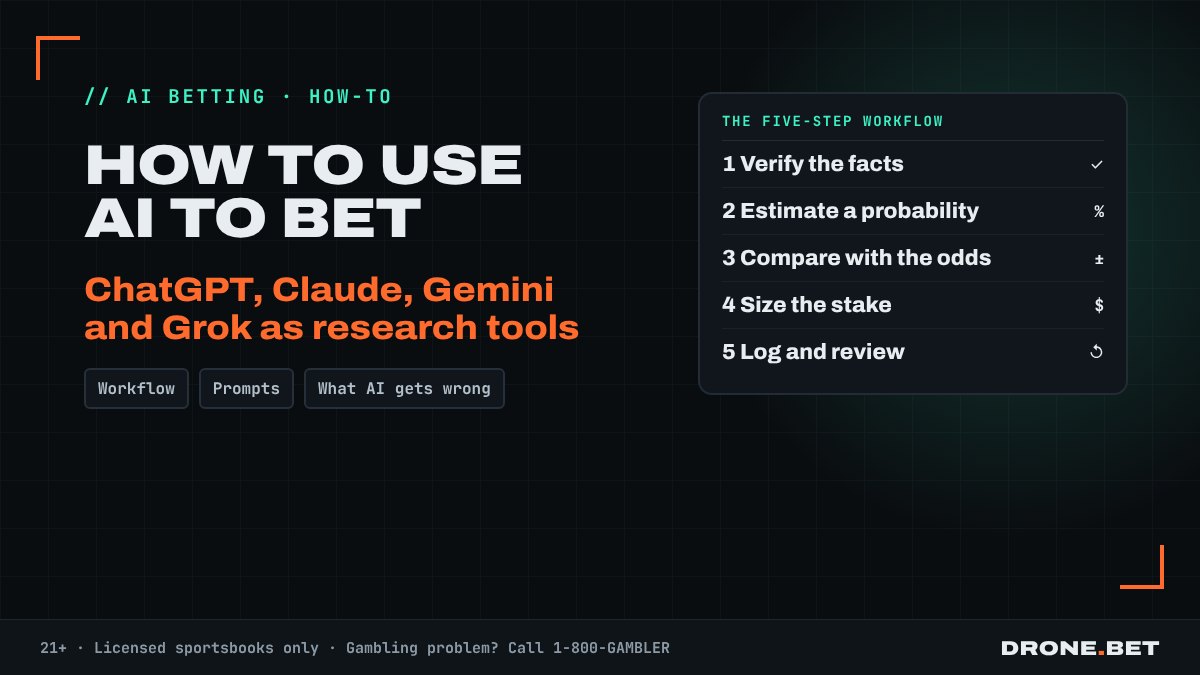
A five-step AI betting research workflow
1. Gather the facts, then verify them
Ask the assistant to summarize the matchup: form, injuries, rest, weather and, for football, recent expected goals. If it has web search, ask it to cite sources. Then check every fact that matters against an official source, such as the team’s injury report or the league’s site. Chatbots can mix up seasons, players and results.
2. Turn the analysis into a probability
Ask for a probability, not a pick. “Team A wins” is useless; “Team A wins 55% of the time” can be tested. Ask the assistant to explain how it reached the number, and push back if the reasoning is vague.
3. Compare it with the odds
Convert the sportsbook’s price into an implied probability and remove the margin. Only when your probability is clearly higher is there a potential bet. Our implied probability calculator and odds converter do this instantly, and odds-comparison tools show which book has the highest price.
4. Size the stake
Bet a small, consistent share of your bankroll. The Kelly criterion gives the mathematically optimal stake for a known edge, but because your probability is only an estimate, most bettors use a fraction of it. Try our Kelly criterion calculator, and treat its answer as a ceiling.
5. Log the bet and review
Record the bet, the probability, the odds you took and the closing odds. Every month, paste the log into your assistant and ask where you are winning and losing. Beating the closing line consistently is the clearest sign you have a real edge.
ChatGPT, Claude, Gemini and Grok compared for betting research
| Assistant | Live web data | Gambling policy | KellyBench result |
|---|---|---|---|
| ChatGPT (OpenAI) | Yes, with ChatGPT search, including live scores | Usage policies list gambling as high risk; real-money gambling apps barred from ChatGPT apps | GPT-5.4 −7.9%; GPT-5.5 −9.6% |
| Claude (Anthropic) | Yes, with web search | Usage policy does not mention gambling | Claude Opus 4.7 −3.7%; Opus 4.6 −11.2% |
| Gemini (Google) | Yes, including live scores and standings | Prohibited-use policy does not mention gambling | Gemini 3.1 Pro −66.0% |
| Grok (xAI) | Yes, real-time search | Acceptable use policy does not mention gambling | Not in the published results |
| Perplexity | Yes, search-first | Acceptable use policy prohibits facilitating real-money gambling | Not tested |
Policies and results come from each company’s published policy pages and General Reasoning’s KellyBench release, checked in November 2026. KellyBench scores are mean returns over the 2023-24 Premier League season.
What the KellyBench test found
The best performers were the models that built more sophisticated strategies and stuck to them, and General Reasoning found a positive link between sophistication and return. Even so, no model made money on average. A strong general assistant can help you think; it does not hand you an edge.
Why live data matters
A model without web search answers from its training data, which can be months old. For betting, that means it may not know about an injury, a transfer or even a result from last week. Turn on search, ask for sources, and still verify anything that would change your bet.
Which AI should you use for sports betting?
“What is the best AI for sports betting?” is one of the most searched questions on the topic, and the honest answer is that it depends on the job.
- For research and explanation: any of the major assistants with web search turned on. Pick the one whose answers you can check most easily, and always ask for sources.
- For finding prices and value: not a chatbot. Odds-comparison and +EV tools read live prices across sportsbooks, which general assistants cannot see.
- For picks with probabilities: a specialist model that publishes its record, judged by the tests in our AI betting tips guide.
- For in-app help: sportsbook assistants such as FanDuel’s AceAI, remembering that they belong to the company taking your bets.
In KellyBench, the strongest results came from models that built careful strategies and stuck to them, but none turned a profit on average. The tool matters less than the discipline you bring to it.
Common mistakes when using AI for betting
- Asking for a pick instead of a probability. A pick hides the reasoning and cannot be tested.
- Trusting facts without checking. Out-of-date injuries and wrong results are the most common chatbot errors.
- Ignoring the price. A correct prediction at a poor price is still a losing bet over time.
- Letting AI build big parlays. Each extra leg multiplies the sportsbook’s margin.
- Changing the question until you get the answer you want. If you keep re-asking until the AI agrees with you, you are using it to confirm a bias, not to test it.
Prompts that work
Copy these and swap in your game. Each asks for reasoning and probabilities rather than picks.
Match preview: “Summarize [Team A] vs [Team B] on [date]. List confirmed injuries and suspensions with sources, recent form over the last five games, and any rest or travel factors. Flag anything you are not sure about.”
Probability check: “Based on the facts above, estimate the probability of each outcome and explain your reasoning step by step. Then convert the odds [+120 / -140] into implied probabilities, remove the margin, and tell me whether either side shows an edge.”
Player prop research: “For [player], list the last ten games for [stat], the opponent’s record against the position, and expected minutes. Estimate the probability of going over [line] and say what would change your view.”
Bankroll plan: “My bankroll is [$X]. My estimated edge on this bet is [Y]% at odds of [Z]. Calculate full Kelly and quarter Kelly stakes and explain the risk of each.”
Log review: “Here is my betting log [paste]. Calculate my return on investment by sport and bet type, my record against the closing line, and point out any patterns in my losing bets.”
Sportsbook AI assistants
Sportsbooks are building their own assistants. FanDuel’s AceAI answers stats and odds questions inside the FanDuel app for all US customers except in Connecticut, using structured data feeds rather than a chatbot’s memory. Only the customer can add a selection to the bet slip, and questions about chasing losses get responsible-gambling resources instead of picks. Remember whose assistant it is: it lives inside the sportsbook that takes your bets.
Specialist apps add AI on top of betting data. Rithmm’s Scout explains picks, Outlier’s AI Analysis weighs trends for and against a prop, and Dimers offers an AI chat assistant. Our AI sports betting apps guide compares them, and our AI betting tips guide explains how to judge their picks.
Building your own AI betting model
You do not need to be a programmer. An assistant can write the formulas for you.
- Football (soccer): a Poisson model turns each team’s expected goals into probabilities for the result, totals and both teams to score. Our AI football betting tips guide explains the method with a worked example.
- NFL: an Elo rating updated after every game, adjusted for home field and quarterback, gives a projected spread. Free play-by-play data from nflverse powers public models such as nfelo. See our AI NFL predictions.
- Horse racing: blending the market price with form, ratings and trainer statistics is the approach behind the free predictors in our AI horse racing tools guide.
Start simple, test it on past seasons before risking money, and compare its probabilities with the closing odds. If it cannot beat the close on paper, it will not beat it with real money.
Using AI for betting responsibly
- Never let an AI agent place bets or move money for you.
- Set deposit and time limits in your sportsbook account before you start.
- Do not use AI to justify chasing losses. A “high-confidence” pick after a losing day is still just a probability.
- Keep stakes small and consistent, whatever the assistant says.
If betting stops being fun, call 1-800-GAMBLER, or in the UK use GAMSTOP and GamCare. Our responsible gambling page lists more support.
21+ in US states (18+ in the UK). Bet only with licensed sportsbooks where online betting is legal. AI is a research tool; it does not guarantee a profit.
FAQ
Can AI help with sports betting?
Yes, as a research assistant. AI can summarise team news, explain statistics, build simple models and keep a betting log. It cannot see the future, it can be wrong about recent facts, and in the most rigorous public test every leading model lost money betting a simulated Premier League season.
Can AI help with betting?
It can help with the work around a bet: researching, converting odds to probabilities, sizing stakes and reviewing results. It should not make the decision for you, and you should check every fact it gives you against an official source before you bet.
What is the best AI for sports betting?
There is no single answer. In General Reasoning's KellyBench test, Claude Opus 4.7 lost the least (−3.7%) and GPT-5.4 came next (−7.9%), but every model lost money. For research, pick an assistant with live web search and check its facts; for prices and value, specialist tools such as odds screens do the job better.
How do I use AI for sports betting?
Use it in five steps: gather and verify the facts, turn your analysis into a probability, compare that probability with the odds, size the stake as a small share of your bankroll, and log the bet. Let the AI help with each step, but make the final call yourself.
How do I use AI for betting?
Ask it to research and calculate, not to pick. Good uses include summarising injuries, converting odds, building a goals or Elo model in a spreadsheet and analysing your betting log for leaks. Always check facts and prices yourself before placing a bet.
Can ChatGPT predict sports results?
It can estimate probabilities and explain its reasoning, but it is not a reliable predictor. Without web search it may not know recent results or injuries, and it can state wrong facts confidently. OpenAI's usage policies also treat gambling as a high-risk activity.
Is it legal to use AI for sports betting?
Yes. Using AI for research is legal. You must still bet with a licensed sportsbook in a state where online betting is legal, or a UK Gambling Commission-licensed bookmaker, and meet the minimum age.
Can AI find value bets?
AI can help you estimate a fair probability and compare it with the odds, which is how value is found. In efficient markets such as NFL spreads or Premier League match results, the edge is small and hard to sustain. Lower leagues and player props offer more room.
Can sportsbooks tell if you use AI?
Sportsbooks see your betting pattern, not your tools. What they react to is consistent winning, especially beating the closing line, which can lead to lower limits on your account whatever method you use.
Can I build my own AI betting model?
Yes. A spreadsheet with an Elo rating or a Poisson goals model is a realistic start, and an AI assistant can write the formulas or Python code for you. Free data such as the nflverse NFL datasets makes it possible without paying for feeds.