// Machine Sports
World Humanoid Robot Games: The Robot Olympics Are No Longer a Gimmick
Beijing's robot Olympics doubled its events, tripled its robots and made most of them run without a remote in 2026. How the World Humanoid Robot Games work, and why they matter.
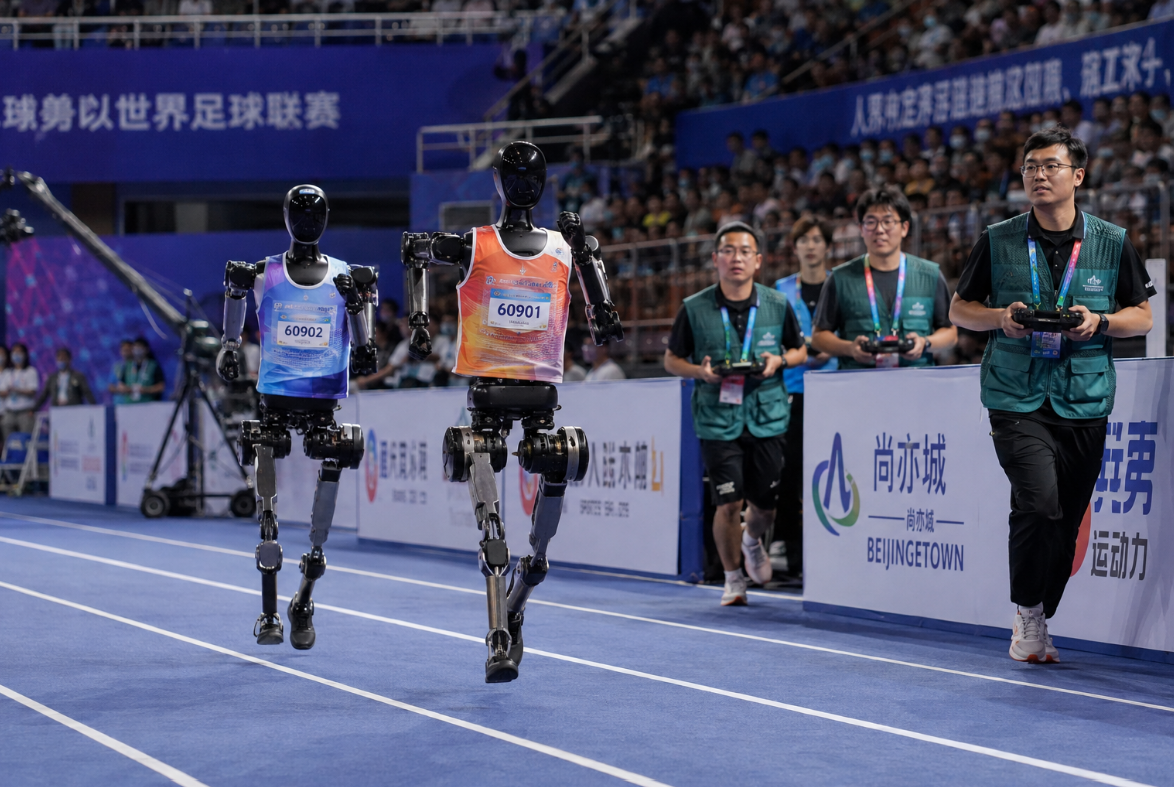
In 2025 the winning 1,500m time at the World Humanoid Robot Games was 6 minutes 34.40 seconds. In 2026 it was 2:21.64. Robots did not get nearly three times faster at middle distance in one year by accident. That number is the best argument that Beijing’s robot Olympics have stopped being a novelty.
The Games are part sport, part trade show and part public stress test for humanoid robots. They are also a statement of intent from the city that hosts them.
What are the World Humanoid Robot Games?
A multi-sport event for humanoid robots, staged in Beijing. Teams from universities, research centers and companies enter robots in athletic contests and in practical “scenario” tasks such as sorting, cleaning and household work.
The first edition in August 2025 drew more than 500 robots from 280 teams across 16 countries. The second, held on August 22–26, 2026, at the National Speed Skating Oval (the “Ice Ribbon” built for the 2022 Winter Olympics), was far bigger.
| 2025 | 2026 | |
|---|---|---|
| Teams | 280 | 666 |
| Events | 26 | 51 |
| Scenario events | 6 | 21 |
| Competition sessions | 487 | 1,301 |
| 1,500m winning time | 6:34.40 | 2:21.64 |
Source: Beijing municipal government. In 2026, 2,056 robots were registered and teams came from 16 countries.
Beijing’s big bet on embodied AI
China has made humanoid robots and “embodied intelligence” a policy priority, and Beijing wants to be the industry’s capital. The Games give local players a global stage. The Beijing Humanoid Robot Innovation Center’s Tiangong robots, Honor’s Lightning and Unitree’s machines all ran in front of international media. Overseas teams from countries including the US, Germany and Japan took part in the first edition.
The commercial side is not subtle. The 2026 venue’s souvenir shop sold more than 200,000 yuan of robot merchandise on opening day. At its market, 28 of 70 stalls were staffed by robots.
What events are included?
Competitive events
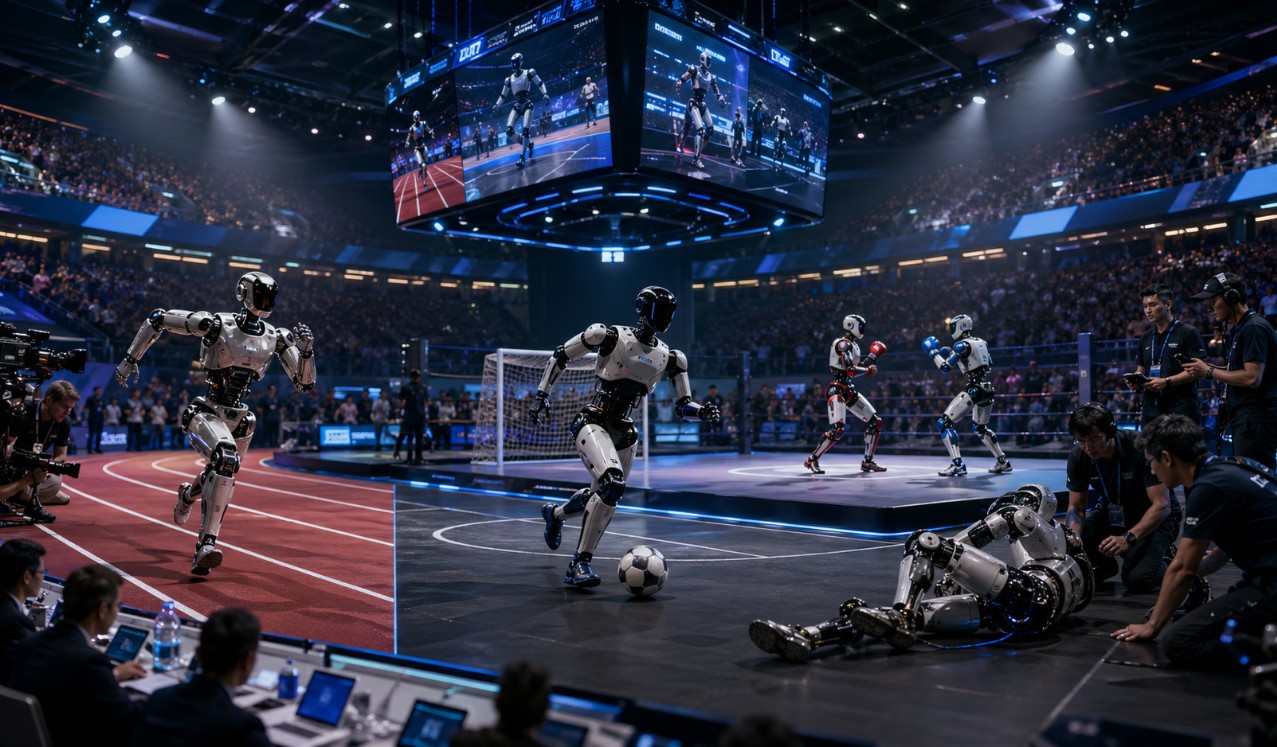
Nine disciplines in 2026: track and field, soccer (5-a-side, plus a 7-a-side exhibition), freestyle fighting, martial arts, dancesport (street dance, ballroom and cheerleading), gymnastics, weightlifting, obstacle races and standing long jump. Weightlifting had two gold medals, lightweight and heavyweight.
Scenario-based events
These matter more to investors. The 2026 Games had 21 scenario events, up from six, covering household chores, hotel service, industrial work and emergency response. Eight more were fine-manipulation tests, such as picking up beans and tightening screws. In the Smart Charging Service event, robots had 30 minutes to unplug, charge and return connectors for three vehicles.
Are the robots autonomous?
Mostly, now. In 2026 all track events and other competitive events had to be completed fully autonomously, except the 100m and 400m hurdle races. Time limits were cut too: the 100m went from three minutes to one, the 1,500m from 40 minutes to 15. Preliminary rounds were scrapped.
That rule change is the story of the year. In 2025 many robots were steered by handlers with remotes, and several collapsed or needed help. Our analysis of what humanoid robots can actually do looks at which skills held up.
The 2026 headline results
Winners as reported by Beijing’s official English portal after the Games closed on August 26:
- 100m (large robots): Tianjiao Team, 8.64 seconds.
- 100m (small robots): Tianxiao Team, 11.98 seconds.
- 400m (small robots): Tiangong Omni, Beijing Innovation Center of Humanoid Robotics, 45.66 seconds.
- 1,500m: Tianzhuo Team, 2:21.64.
The full breakdown, including the sub-Bolt heats, is in our World Humanoid Robot Games 2026 results report.
The half-marathon context
The Games sit alongside Beijing’s humanoid half-marathon. In April 2026 Honor’s Lightning robot finished in 50 minutes 26 seconds. The 2025 winning time was 2 hours 40 minutes 42 seconds. Different event, same trend line.
Is this the beginning of robot sports betting?
Not yet. Sportsbooks need stable rules, verifiable participants and a results history. The Games changed their autonomy rules, time limits and event list between editions. There is also no independent way for a bettor to confirm that a robot is running its own software. No US state-regulated or UK-licensed sportsbook offers markets.
Speed records and autonomy milestones are the kind of questions prediction markets tend to list. We track AI contracts in our AI prediction markets guide. Trading event contracts involves risk of loss.
The military shadow
Balance, perception and manipulation are dual-use skills. A robot that can carry a load over rubble in an emergency-response event has obvious applications outside sport. That is part of why governments watch these Games closely. It is also why the sport’s combat cousins, covered in our robot combat sports hub, draw regulatory attention.
How to watch next time
Both editions have been held in Beijing in August. Tickets were sold through Chinese platforms such as Damai and Maoyan and, for overseas buyers, Damai International. In 2026, competition-day tickets started at 98 yuan and ceremony tickets at 128 yuan. Dates for a third edition have not been published yet.
If you are planning a trip, competition days offer the most action for the price. The final two days carry the fighting and soccer finals.
Our view
The World Humanoid Robot Games are the most useful public benchmark the humanoid industry has. Failures happen on camera, rules force autonomy and results are timed. Robots now outrun humans over 100m and 1,500m. They still struggle to fold a shirt. Watching that gap close, one edition at a time, is the reason to pay attention.
FAQ
What are the World Humanoid Robot Games?
A multi-sport competition for humanoid robots held in Beijing. The first edition ran in August 2025. The second, on August 22–26, 2026, at the National Speed Skating Oval, had 51 events, 666 teams and 2,056 registered robots.
Are the robots at the World Humanoid Robot Games autonomous?
In 2026 all track events and other competitive events had to be completed fully autonomously, except the 100m and 400m hurdle races. Some scenario events allowed teleoperation but scored it at half weight.
What events are in the World Humanoid Robot Games?
Competitive events include track and field, soccer, freestyle fighting, martial arts, dancesport, gymnastics, weightlifting, obstacle races and standing long jump. Scenario events test household, hotel, industrial, emergency and fine-manipulation tasks.
When is the next World Humanoid Robot Games?
Organizers have not published dates for a third edition. Both editions so far have been held in Beijing in August.
Can you bet on the World Humanoid Robot Games?
No US state-regulated or UK-licensed sportsbook offers markets on the Games. Rules change each year and autonomy is hard to verify, which makes fair pricing difficult.