







// Guide
AI Football Betting Tips: How Machines Read the Premier League and La Liga
How AI football betting tips are made for the Premier League, La Liga and the Champions League, which markets models read well, what the tests show and how to use AI tips without fooling yourself.
AI football betting tips are everywhere, from free prediction sites to apps promising “AI-picked accas”. Underneath most of them sits the same idea: estimate how many goals each side should score, turn that into probabilities, and compare them with the bookmaker’s price. Done well, it is a sharp way to read a match. Done badly, it is a tipster with a new logo.
This guide explains how AI reads the Premier League and La Liga, which betting markets it handles well, what the most rigorous test of AI betting found, and how to use AI football tips sensibly. American readers looking for NFL picks should head to our AI NFL predictions.
How AI football betting works: expected goals
Goals are rare and noisy. A team can dominate a match and lose 1-0 to a deflection. Expected goals fixes that by scoring the quality of each chance rather than the result.
From shots to xG
An xG model compares every shot with thousands of similar historical shots. Inputs include distance and angle to goal, whether it was a header or a kick, the type of pass that created it and how the attack developed. Opta’s model, used by FBref, also weighs defensive pressure, the goalkeeper’s position and how clear the path to goal was. A penalty is worth a fixed 0.79 xG in that model.
Shots in the same move are not simply added. If a possession produces chances worth 0.41, 0.47 and 0.79 xG, the probability that at least one goes in is 1 − (0.59 × 0.53 × 0.21), or about 0.93 xG, not 1.67.
From xG to match probabilities
A betting model then estimates how many goals each team should score in the next match. It usually starts from rolling xG for and against, adjusted for opponent strength and home advantage. Those averages feed a Poisson distribution, a standard formula that turns an expected goal count into the probability of 0, 1, 2 or more goals.
A worked example: say the model expects the home side to score 1.6 goals and the away side 1.1, a combined 2.7. Under a simple Poisson model, the chance of no goals is e−2.7, about 6.7%. The chance of two or fewer goals is roughly 49.4%, so over 2.5 goals is about 50.6%, a fair decimal price of around 1.98. If a bookmaker offers 2.10, the model sees value; at 1.85 it does not. Our expected value calculator does that comparison for you.
Where the models go wrong
- Independence. Basic Poisson treats both teams’ goals as unrelated, which understates draws. Better models add a correlation adjustment.
- Team news. A model trained on last season’s xG does not know the striker is injured, the manager just left or the side is resting players for Europe.
- Small samples. Six games of xG is a hint, not a rating.
- The market knows too. Bookmakers and sharp bettors use xG. In big leagues, the edge from public xG data is mostly priced in.
AI Premier League tips: what the models look at
The Premier League is the most heavily modelled football league in the world, which cuts both ways. Data is rich: every shot, pass and pressure is logged, and expected goals models are mature. But bookmakers and professional bettors use the same data, so prices on big matches are sharp.
Where AI earns its keep is in the details the headline price can lag on:
- Rotation. Clubs in European competition rotate heavily around midweek games. A model that adjusts for the expected line-up beats one that rates the club as a whole.
- Underlying form. A side winning narrowly while conceding far more expected goals than it creates is often overrated by its league position.
- Goals markets. Totals and both teams to score depend on combined attacking and defensive output, which expected goals estimates more reliably than the winner.
Google’s own Gemini has become the official AI partner of Arsenal and Liverpool, among other clubs, which says something about where the sport is heading. It does not mean a chatbot can price a match better than the market.
La Liga through an algorithm
La Liga rewards a league-specific reading. A model trained mostly on English football will misjudge it unless it is calibrated on Spanish data, because tempo, scoring levels and home advantage differ from league to league. Three things matter most:
- Team-level totals. Where a side’s matches carry low expected goals, a model leans towards unders and against both teams to score; where both sides create plenty, it leans the other way. League averages hide big differences between teams.
- Big favourites. When Real Madrid or Barcelona are heavy favourites, the match result market offers little value either way. Handicaps and goals lines are where a model’s view can matter.
- Relegation battles. Late-season matches between struggling sides are tight and cagey, and draws become more likely than a basic model allows.
Champions League and the wider European game
European competition is harder for models, because teams from different leagues rarely meet and their ratings have to be compared indirectly. Club form in domestic leagues does not translate neatly, and knockout ties change incentives: a side protecting a first-leg lead plays differently. Use AI probabilities here as a starting point, not a final number.
The same applies to Serie A and the Bundesliga: a model should be calibrated on each league’s own data rather than borrowing ratings from the Premier League.
Goals, results and correct scores: where AI football tips work
A probability is only useful if you apply it to the right bet. Each soccer market reacts differently to model output.
1X2 and draw no bet
The three-way market is where models struggle most, because draws are hard to predict and books price them carefully. Say a model rates a home side well above the market but has no strong view on the draw. Draw no bet, which refunds your stake on a draw, captures that edge with less noise.
Totals and both teams to score
Goal markets are where xG earns its keep. Totals depend on the combined goal expectation, which xG estimates more reliably than the winner. Both teams to score depends on each side’s chance of scoring at least once. Take a home expectation of 1.6 goals and an away expectation of 1.1. A basic Poisson model puts the home side scoring at about 80% and the away side at about 67%, so both scoring at roughly 53%.
Correct score
Correct-score predictions make for good headlines and poor bets. Even the most likely scoreline rarely carries more than a 12 to 15% chance, and bookmakers build big margins into these markets.
Accumulators
Stacking several AI tips into an accumulator multiplies the bookmaker’s margin as well as the odds. If you combine legs, check what you are giving up with our accumulator (parlay) calculator.
Did AI beat the bookies? The Premier League betting test
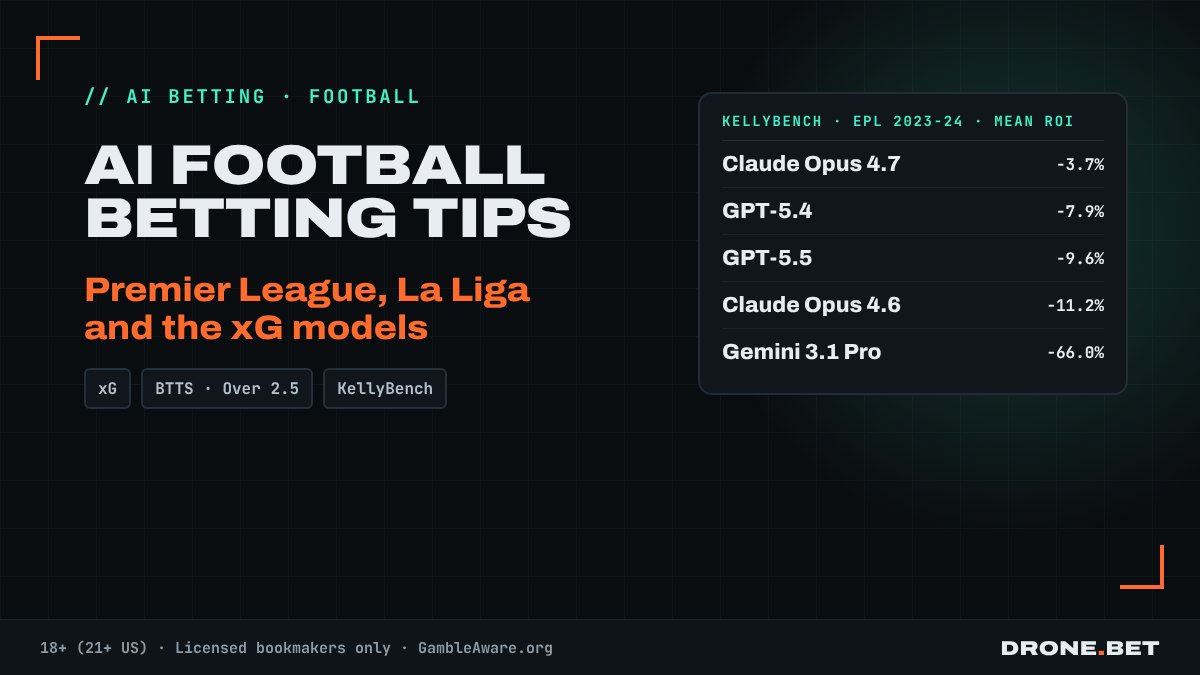
In April 2026 the AI lab General Reasoning published KellyBench, the most rigorous public test of AI football betting so far. It gave 12 leading AI models a simulated £100,000 bankroll and asked them to bet their way through the 2023-24 Premier League season, building models, finding value and sizing stakes as the season unfolded.
Every model lost money on average. The closest to breaking even was Claude Opus 4.7 at −3.7%, followed by GPT-5.4 at −7.9%; Gemini 3.1 Pro lost 66% and Mistral Large 98.8%. The authors found the models struggled to act consistently over a long season, often failing to act on their own analysis or adapt as conditions changed.
The takeaway for anyone following AI football tips: a model can read a match well and still lose money if it ignores price, bets too much or does not adapt. The edge, where there is one, comes from discipline around the probabilities, not the probabilities alone.
AI football betting apps and sites: what to look for
These services publish football probabilities or tips. None publishes an independently audited record, so treat each as an input you can test.
- Forebet: free probabilities for more than 800 leagues, with 1X2, predicted score, goals, both teams to score, corners and cards. Its app says the models use machine learning on data going back to 2000.
- xGscore: describes neural networks that weight recent expected goals by date, venue and opponent, then convert them to probabilities and compare them with bookmaker odds.
- Football xG: predictions built on expected goals data, free for three leagues, with Core at $26 a month for 30 leagues and Pro at $39 for 50.
- PredictZ and WinDrawWin: free daily tips and correct-score forecasts, useful for context rather than pricing.
- Dimers: simulation-based predictions covering the Premier League and La Liga, with an AI chat assistant, Dimebot. Dimers Pro costs $29.99 a month.
- BetQL: star-rated model bets for the Premier League, La Liga, Bundesliga, Serie A and the Champions League.
Whichever you use, look for probabilities rather than bare picks, a record that shows the odds at the time, and an honest description of the method. Walk away from anything promising “guaranteed” or “fixed” tips.
Using a chatbot for football tips
ChatGPT, Claude, Gemini and Grok can summarise team news, explain expected goals and help you build a simple goals model in a spreadsheet. They are weak at live information, and can state out-of-date injuries or results with confidence. Our guide to using AI for sports betting sets out prompts and a step-by-step method that checks every fact.
Setting limits on AI football bets and getting help
AI tips can make betting feel more scientific than it is. In the UK you must be 18 or over and use a bookmaker licensed by the Gambling Commission. Set deposit limits before you start, never chase losses with a “sure” AI tip, and use GAMSTOP to block all UK-licensed sites if you need a break. Free, confidential support is available from GamCare and GambleAware.
18+ (21+ in US states). Bet only with licensed bookmakers. Please gamble responsibly.
FAQ
Can AI predict football results?
AI can estimate the probability of each result from expected goals, form, injuries and team news, but it cannot predict results with certainty. Even good models pick the correct match result only about half the time, because draws are common and goals are rare.
Are AI football betting tips worth paying for?
Only if the service publishes every tip with the odds and a timestamp before kick-off, over hundreds of matches. Free sites such as Forebet and xGscore show probabilities at no cost, so a paid service has to prove it beats them and the closing price.
How does AI predict Premier League matches?
Most models estimate how many goals each side should score from rolling expected goals for and against, adjusted for opponent strength and home advantage. A Poisson distribution then turns those goal expectations into probabilities for the result, totals and both teams to score.
Which football markets suit AI tips?
Goals markets. Over/under and both teams to score depend on combined goal expectation, which expected goals models estimate well. Match results are harder because draws are difficult to predict, and correct scores rarely exceed a 15% chance.
Did AI models make money betting on the Premier League?
Not in the most rigorous public test. In General Reasoning's KellyBench study, published in April 2026, 12 leading AI models bet through the 2023-24 Premier League season with a simulated £100,000 bankroll, and every one lost money on average.
Is xG used in AI football models?
Yes. Expected goals, or xG, scores the quality of each chance rather than the result, which makes it a better guide to future scoring than goals alone. Sites such as xGscore and Football xG build their predictions on it.
Are AI football tips legal in the UK?
Yes. Using tips or prediction tools is legal. You must be 18 or over and bet with a bookmaker licensed by the Gambling Commission. Tipsters advertising in the UK must not claim guaranteed wins, and the Advertising Standards Authority has ruled against an AI tips ad claiming 97% accuracy.
Why do AI football tips struggle with draws?
Basic models treat each team's goals as independent, which understates how often matches finish level. Draws are also priced carefully by bookmakers, so there is little room for an edge. Many bettors use draw no bet to back a model's view without the draw risk.