// AI Motorsports
Human 5, AI 4: How Minchan Kim Beat the Machine at the A2RL Drone Championship
A human pilot beat the fastest autonomous drone in the field 5–4 in Abu Dhabi after the machine clipped a gate in the deciding heat. How it happened, and what it says about autonomous racing.
Nine heats, one camera each, and a gate that decided it. At the A2RL Drone Championship in Abu Dhabi in January 2026, South Korean pilot Minchan Kim and TII Racing’s autonomous drone split the first eight races 4–4. In the decider, the AI clipped a gate and could not recover. Kim won 5–4.
Nine months earlier, at the same event, an AI had beaten three former world champions. The rematch went the human’s way, narrowly, and the margin says a lot about where autonomous flight stands.
The A2RL Drone Championship 2026 at a glance
- Dates: January 21–22, 2026
- Venue: ADNEC Centre, Abu Dhabi, during the UMEX unmanned systems exhibition
- Organizer: ASPIRE, the innovation arm of Abu Dhabi’s Advanced Technology Research Council
- Prize pool: $600,000
- Season: second edition of the A2RL Drone Championship
How the human beat the AI
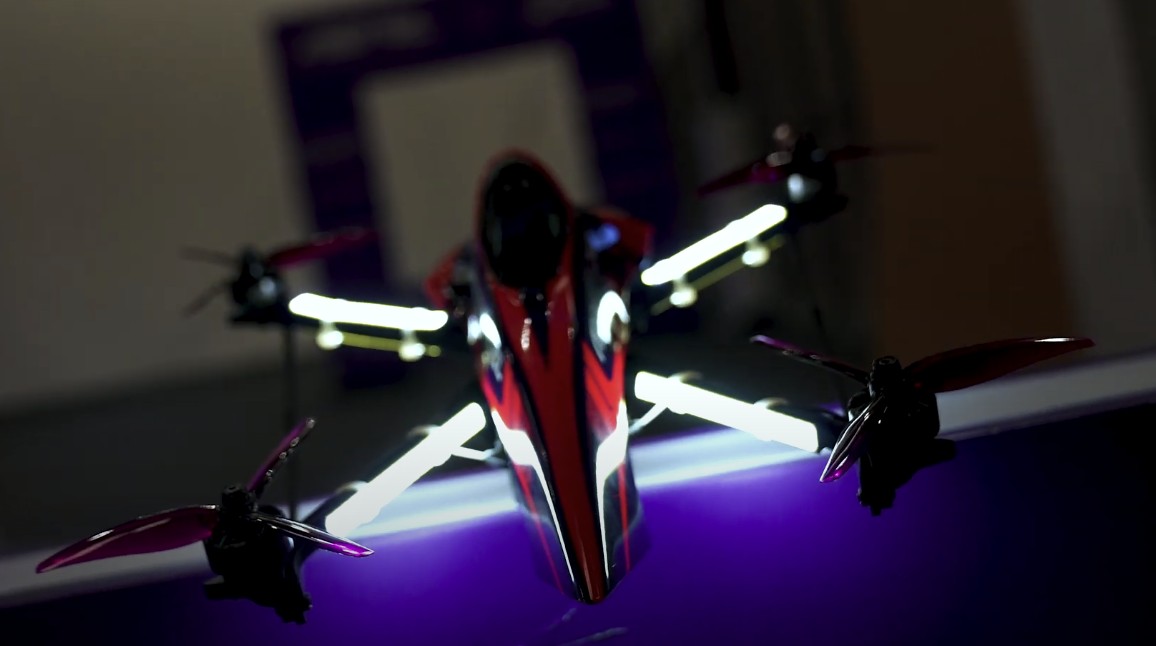
The Human vs AI Challenge was a best-of-nine head-to-head. Kim, a former DRL world champion, faced the drone from TII Racing. The team, from Abu Dhabi’s Technology Innovation Institute, had just set the fastest autonomous lap of the event.
According to TII’s own account, Kim let the AI take early leads in the opening heats and focused on controlled lines. As the series went on, crashes started to appear in the AI’s runs. At 4–4, the drone hit a gate pushing to keep pace and stayed down.
“When I fly with AI, I see the AI in front of my camera view, and it makes me so nervous.” Minchan Kim
His pre-race routine was simpler than the machine’s: “I can do it, I can do it, I can do it.”
The deciding factor: recovery
TII senior researcher Aaesha Al Shehhi was blunt about the gap. “The privilege that he has is that he can recover,” she said. A human who clips a gate can often save the run. An AI trained on clean laps may not know how.
She also pointed to perception. “If the drone is not trained for certain lighting, it can affect the camera,” she said. The team now trains its models with disturbances such as lighting changes and nearby drones.
The rest of the results
The AI-only races showed how fast the machines have become, per A2RL’s official results:
| Race | Winner | Detail |
|---|---|---|
| AI Speed Challenge | TII Racing | 12.032s lap; MAVLAB second at 12.832s |
| AI Multi-Drone Gold Race | MAVLAB | Also took the multi-drone title |
| AI Multi-Drone Silver Race | FLYBY | |
| Human vs AI Challenge | Minchan Kim | 5–4 over TII Racing |
TII Racing is about two and a half years old, Al Shehhi said, competing against teams with more than a decade in the field. “This year, we managed to be the fastest team in the world.”
Four drones, one command
Earlier on finals day, organizers launched four autonomous drones simultaneously from a single command, which TII described as believed to be a first. The result was messy: two clipped gates early, one flew off course and one completed the track cleanly. Multi-agent racing is where the next round of progress has to come.
The rules that make it fair
Every autonomous drone flew with one forward-facing monocular RGB camera and an inertial measurement unit. LiDAR, stereo vision, GPS and external positioning systems were banned. The idea is to give the AI roughly what a human pilot sees through FPV goggles, so gains must come from software, not sensors.
“What stands out this year is the collective progress across the field,” said Stephane Timpano, CEO of ASPIRE. Teams were reaching higher speeds with greater stability, he said, almost entirely through software. TII Racing’s technical director Giovanni Pau said the fastest lap “reflects the depth of our software development and testing.”
From AI win to human win: the 2025 context
The first A2RL x DCL Autonomous Drone Championship, in April 2025, went the other way. TU Delft’s MAVLab won the AI Grand Challenge, covering two laps and 22 gates of a 170-meter course in 17 seconds. It then beat a world-leading human pilot, per the Khaleej Times. MAVLab says its AI beat three former DCL world champions in a knockout, reaching 95.8 km/h, with a neural network that commands the motors directly.
That event had a $1 million prize pool. Our A2RL x DCL coverage has the full story.
Who is Minchan Kim
Kim, who races as MCK FPV, has one of the deepest résumés in FPV racing. He joined Britain’s XBlades at 16 and won DCL Pilot of the Year in 2020. He went into DRL’s February 2025 Miami Invitational as defending world champion.
He was not done after Abu Dhabi. In October he won the MultiGP Championship in Carrollton, Texas, his third MultiGP title, after nearly two years away from elite FPV competition, per MultiGP. He set the event’s fastest lap and went undefeated through the A Main. Our MultiGP finals page has the results.
What the 5–4 result means
The speed gap has closed. On a clean track, the AI was already quick enough to lead heats against one of the world’s best pilots. TII’s 12.032-second lap shows how fast vision-only autonomy has become.
The reliability gap has not. Kim won because the machine could not recover from contact. That is the same problem facing autonomous cars, which A2RL races in a separate series; see our A2RL autonomous car racing guide.
The next match is close to a coin flip. A best-of-nine that goes to a deciding heat is about as close as sport gets. If the AI teams solve recovery, the human edge may not survive another season.
Can you bet on human vs AI?
We found no regulated sportsbook or prediction market that listed this race. Binary human-vs-machine outcomes suit event contracts well, though, and prediction markets already trade AI questions, such as which company will have the top-ranked AI model at year end. Our AI prediction markets guide explains what trades and where.
Which company has the best AI model at the end of 2026?
Prices from Polymarket, October 22, 2026 23:16. Not a recommendation. See market
Trading event contracts involves risk of loss. Availability varies by state, and several states are challenging prediction markets in court.
FAQ
Who won the human vs AI race at the A2RL Drone Championship 2026?
South Korean FPV pilot Minchan Kim beat TII Racing's autonomous drone in a best-of-nine. The match was tied 4–4 before the final heat, in which the AI drone struck a gate and could not recover, giving Kim a 5–4 win.
When and where was the A2RL Drone Championship 2026?
It ran on January 21–22, 2026, at ADNEC Centre in Abu Dhabi, alongside the UMEX unmanned systems exhibition. It was the second season of the championship, organized by ASPIRE.
What was the prize money at the A2RL Drone Championship?
The 2026 championship carried a total prize pool of $600,000 across its race formats. The inaugural 2025 edition, run with the Drone Champions League, offered $1 million.
What sensors do A2RL autonomous drones use?
Each autonomous drone flies with a single forward-facing monocular RGB camera and an inertial measurement unit. LiDAR, stereo vision, GPS and external positioning systems are banned.
Did AI beat humans at drone racing before?
Yes. At the first A2RL x DCL championship in April 2025, TU Delft's MAVLab AI beat three former DCL world champions in a knockout against human pilots.