// AI Motorsports
A2RL Autonomous Drone Championship: AI Beat the Humans, Then Lost by One Gate
In April 2025 an AI drone from TU Delft beat elite human pilots in Abu Dhabi. Nine months later a former DRL world champion won it back by a single race. What happened, and why software decides these races.
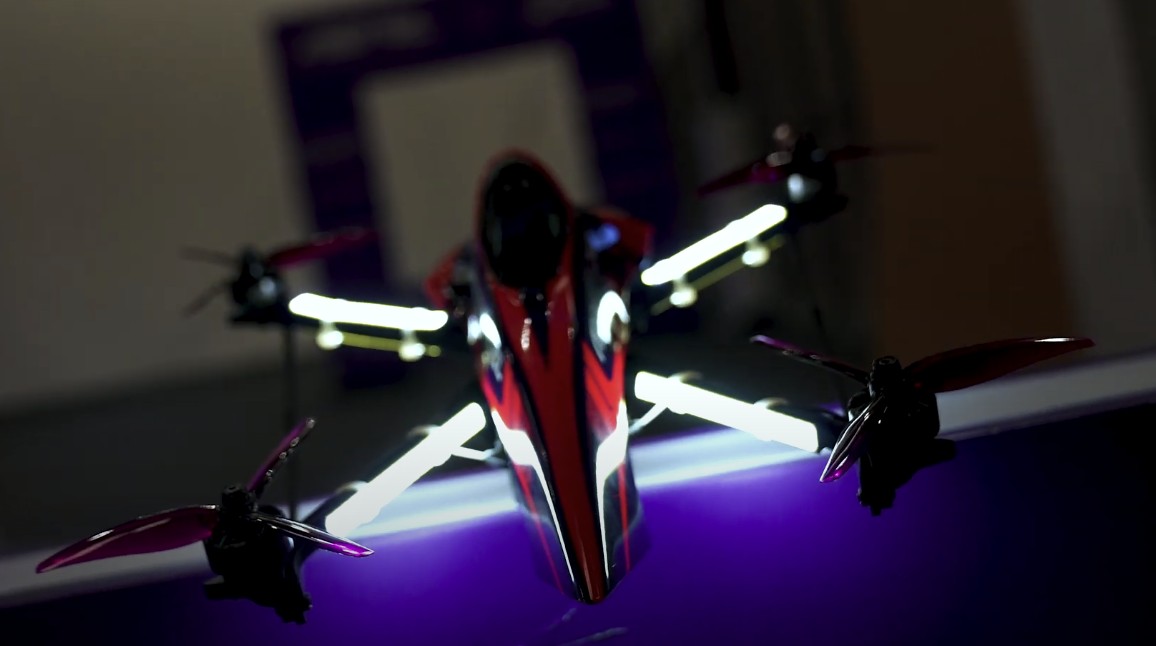
The AI was one race from beating the world champion. On the deciding run of a best-of-nine Human vs AI finale in Abu Dhabi in January 2026, TII Racing’s autonomous drone pushed for pace, struck a gate and could not recover. MinChan Kim, the former DRL World Champion, took the series 5–4.
Nine months earlier the same contest went the other way. At the first A2RL x DCL Autonomous Drone Championship in April 2025, MAVLab’s AI drone from TU Delft beat elite human FPV pilots. Two events in, autonomous drone racing already has a rivalry and a rulebook built to make things hard for the machines. It also has a clear answer to who matters most: the software team.
What the A2RL x DCL autonomous drone championship is
A2RL is the Abu Dhabi Autonomous Racing League, run by ASPIRE, the grand-challenges arm of the UAE’s Advanced Technology Research Council (ATRC). It is better known for driverless single-seaters, which we cover in our A2RL autonomous car race guide.
For the first drone event it partnered with the Drone Champions League (DCL), the team-based FPV series that brought the track design and the elite human pilots. Every team flies the same aircraft. No hands touch the controls. The difference between first and last is code.
Season 1, April 2025: MAVLab’s near-sweep
The 2025 finale ran on April 11–12 at ADNEC Marina Hall with a US$1 million prize pool. Fourteen finalist teams came through two qualifying rounds from hundreds of entrants. They represented 11 countries, including the UAE, Netherlands, South Korea, China, Canada and the US.
Each team flew a standardized drone carrying an NVIDIA Jetson Orin NX module, a forward-facing camera and an IMU, at speeds above 150 km/h. There were four formats:
- AI Grand Challenge: a solo time trial on a 170-meter track, two timed laps for a valid finish.
- AI vs Human: the top four AI teams against DCL’s elite FPV pilots in knockout rounds.
- Multi-drone Race: four autonomous drones on track at once, testing collision avoidance.
- AI Drag Race: a straight-line test of acceleration and stability.
According to the Abu Dhabi Media Office results, MAVLab won the AI Grand Challenge (two laps through 22 gates in 17 seconds), the AI vs Human race and the Drag Race. TII Racing, from Abu Dhabi’s Technology Innovation Institute, won the Multi-drone Race. MAVLab took the largest share of the prize money.
“Winning the AI Grand Challenge and the AI vs Human race is a huge milestone for our team.” Christophe De Wagter, MAVLab team principal
Off the track, an A2RL x DCL STEM program built with UNICEF trained more than 100 Emirati students. Over 60% earned Trusted Operator Program certification and 24 scored full marks.
Season 2, January 2026: faster laps, harder rules
The second edition, branded the A2RL Drone Championship, ran on January 21–22, 2026, during the UMEX exhibition in Abu Dhabi. It carried US$600,000 in prize money. The headline change was the sensor budget.
Racing with one eye
Drones flew fully autonomously with a single forward-facing monocular RGB camera and an IMU. LiDAR, stereo vision, GPS and external positioning systems were banned. That forces the AI to estimate depth, speed and gate position from one video feed and an accelerometer, roughly what a human FPV pilot works with through goggles.
2026 results
| Format | Winner | Detail |
|---|---|---|
| AI Speed Challenge | TII Racing | Fastest autonomous lap, 12.032s (MAVLAB 12.832s) |
| Multi-Drone Gold Race | MAVLAB | Multi-drone coordination |
| Multi-Drone Silver Race | FLYBY | Second-tier final |
| Human vs AI (best of nine) | MinChan Kim | Won 5–4 over TII Racing |
The official A2RL results release says the Human vs AI finale was tied 4–4 going into the last run. Kim held his line. The AI chased, clipped a gate and was out.
ASPIRE CEO Stephane Timpano said teams had found higher speeds and more consistency than in Season 1, “driven almost entirely by software advances.” TII Racing technical director Giovanni Pau credited the team’s software development and testing for the fastest lap.
Why software, not hardware, decides autonomous drone races
Spec hardware makes A2RL a clean experiment. With the airframe, compute and sensors fixed, a team’s advantage lives in three places. Perception finds the next gate in a blurry frame. Planning chooses a racing line at 100+ km/h. Control executes it without overcorrecting.
The 2026 Human vs AI result shows where the gap still sits. The AI is quick enough to force a decider against a world champion, but its recovery is brittle. A human who clips a gate can often fly through the wobble. An autonomous stack that loses its visual fix usually cannot. Closing that gap is now the main engineering prize.
Where autonomous drone racing goes next
A2RL has not announced dates for a third drone season. The same idea is spreading, though. The DCL is running the race series for Anduril’s AI Grand Prix, a fully autonomous drone race with a US$500,000 prize pool. It uses spec drones built by Neros Technologies, and the final is scheduled for November 2026 in Columbus, Ohio. No hardware modifications are allowed, so once again the edge comes from code.
Human FPV racing carries on alongside. The MultiGP Championship crowned its 2026 champion in Texas in October. A2RL’s driverless cars raced in Europe for the first time at Imola in September. For autonomous car racing in the US, see our Indy Autonomous Challenge explainer.
Can you bet on AI drone racing?
Not at a sportsbook. No US state-regulated or UKGC-licensed bookmaker lists A2RL drone markets, and the events are too infrequent for operators to price.
The closest thing is the AI trade itself. CFTC-regulated prediction markets list event contracts on technology questions. We track the ones tied to AI labs and model rankings in our AI prediction markets guide. They are not markets on these races, and availability depends on your state. Trading event contracts involves risk of loss.
FAQ
Who won the A2RL Drone Championship in 2026?
TII Racing set the fastest autonomous lap (12.032 seconds) in the AI Speed Challenge, and MAVLAB won the Multi-Drone Gold Race. Human pilot MinChan Kim beat TII Racing 5–4 in the best-of-nine Human vs AI finale.
Did AI beat human pilots at the A2RL x DCL championship?
Yes, in April 2025 MAVLab's autonomous drone from TU Delft beat elite human FPV pilots. In January 2026 the result flipped: the human won the decider after the AI drone struck a gate.
What sensors do A2RL autonomous drones use?
In the 2026 championship, drones flew with a single forward-facing monocular RGB camera and an IMU. LiDAR, stereo vision, GPS and external positioning were banned.
How much prize money does the A2RL drone championship pay?
The April 2025 A2RL x DCL event carried a US$1 million prize pool. The January 2026 A2RL Drone Championship paid US$600,000 across its race formats.
Can you bet on autonomous drone racing?
Not with US or UK regulated sportsbooks, which do not list A2RL drone markets. Prediction markets cover AI and tech questions, but there is no listed market on these races.


