



// Guide
AI Prediction Markets: AI Agents, Trading Bots and Markets on AI
AI prediction markets in both senses: AI agents and bots that trade Kalshi and Polymarket, and the markets that price the AI race itself. How they work, how they settle, how AI forecasts compare with markets, and the US rules.
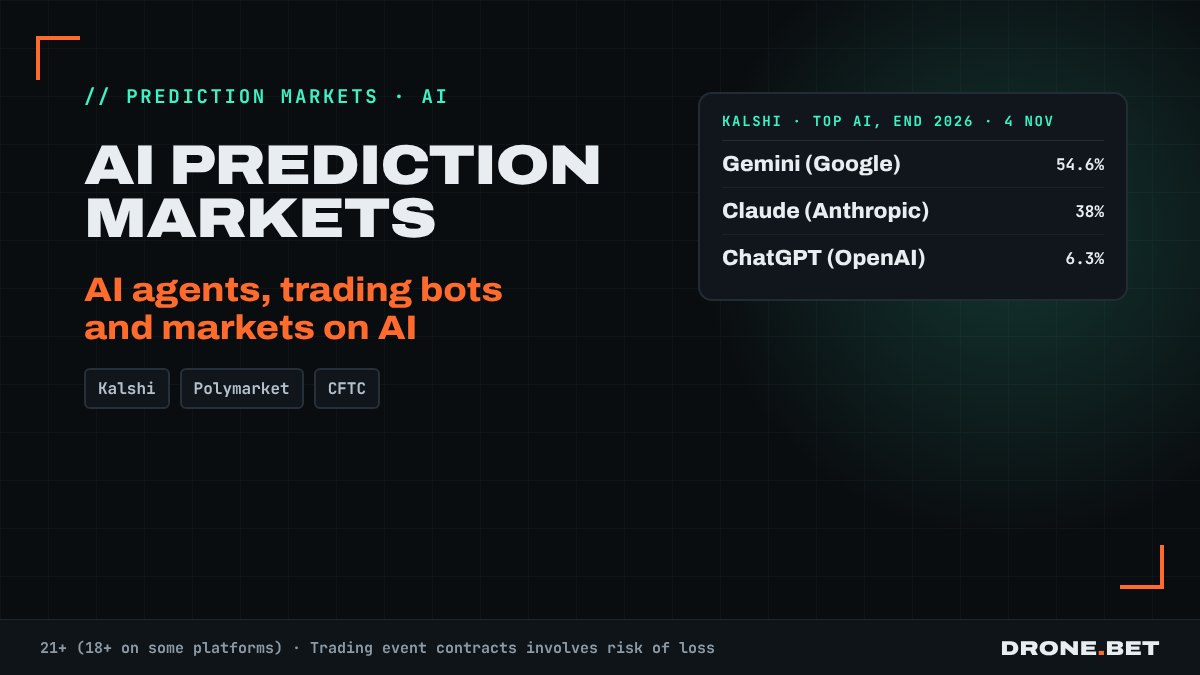
AI prediction markets mean two different things, and both are growing fast. The first is AI trading the markets: agents and bots that read the news, estimate probabilities and buy event contracts on Kalshi or Polymarket. The second is markets on AI: contracts that pay out on which company has the top AI model, when a lab releases its next system or whether a company goes public.
On November 4, 2026, Kalshi’s “Best AI at the end of 2026?” market priced Google’s Gemini at 54.6% and Anthropic’s Claude at 38%, with about $17 million traded. On Polymarket’s international site, Google traded at 59% and Anthropic at 32%. We explain how both kinds of AI prediction market work, how the AI contracts settle, how AI forecasts compare with market prices, and what US rules apply.
Two meanings of AI prediction markets
- AI in prediction markets: software that reads data and trades event contracts, from simple bots to large-language-model agents. The platforms are starting to build for them.
- Prediction markets on AI: contracts on the AI industry itself, settled on public leaderboards, release announcements and company filings.
Which company has the best AI model at the end of 2026?
Prices from Polymarket, November 15, 2026 12:04. Not a recommendation. See market
AI agents and trading bots on event contracts
What the platforms offer
Kalshi has built its API with AI in mind. Its developer documentation says the API “gives developers and AI agents programmatic access to live event-contract markets” and includes etiquette for agents, such as citing market links and timestamping prices. In October 2026 Kalshi added read-only portfolio access for AI tools connected through MCP, the protocol many assistants use to reach outside services. Those grants can read balances and positions but cannot place orders or move money.
Polymarket published an open-source framework, “Polymarket Agents”, for building AI agents that trade its markets, but archived it in May 2026. Its terms bar US persons from trading the international platform, including through APIs or agents.
Broker and third-party AI agents
In September 2026 the brokerage Public launched AI agents for prediction markets with Kalshi, letting its members trade Kalshi contracts themselves or let Public’s AI agents trade for them. The agents are Public’s product, not Kalshi’s.
Betting-tool companies have moved in too. OddsJam’s Prediction Traders plan follows algorithmically selected traders on Kalshi, Polymarket, ProphetX and Novig for $449.99 a month in its app, while Unabated, Rithmm, Sharp App and OddsShopper show prediction-market prices next to sportsbook odds. Our AI sports betting apps guide compares them.
Is the edge disappearing?
Probably, for simple strategies. When bots watch every market, obvious mispricings and gaps between venues close in seconds, and the traders left with an edge are the ones with better information or better models. For an individual, the practical lesson is to avoid competing on speed and to trade only where you have a view the market has not priced.
Markets on AI: which contracts you can trade
The AI category has grown from a novelty into dozens of active contracts across the two biggest platforms.
Top-model markets
The flagship type. Polymarket lists “Which company has the best AI model end of 2026?” alongside monthly versions for the end of October and November. Spin-offs cover the second- and third-placed lab, the top AI agent, the top coding model on Arena’s WebDev board, and the top text-to-image model.
Kalshi runs its own year-end top-model market, plus markets on which AI company will have the top coding model at the end of 2026 (Anthropic was at 77% on November 4) and which AI will first reach 1550 on Arena’s text leaderboard.
Release and milestone markets
Kalshi has run series on GPT and Gemini release dates and a DeepSeek V4 release. It has also asked whether OpenAI achieves AGI, an AI passes a Turing test or AI solves a Millennium Prize problem. Polymarket lists markets on AI and the Millennium Prize too. It also asks whether the AI bubble bursts by June 30, 2027, a contract that sat around 22% in October.
Corporate and IPO markets
Company markets track boardroom events rather than benchmarks. Kalshi has listed series on OpenAI board changes, executive departures and whether Sam Altman gets super-voting shares at an IPO. These settle on public filings and announcements, so they behave more like event-driven stock trades than leaderboard races.
How top-model markets resolve
Nearly every best-model contract settles on the same source: the Arena text leaderboard, the crowd-ranked benchmark formerly known as LMArena and now hosted at arena.ai. The Polymarket market page names lmarena.ai as its resolution source and December 31, 2026, as its end date.
How the leaderboard works
Arena shows users two anonymous model answers to the same prompt and asks which is better. The leaderboard says its rankings are powered by millions of these human votes. A statistical model (Bradley-Terry, a cousin of chess Elo) turns the head-to-head results into scores.
The style control switch
This setting decides who gets paid. In August 2024, Arena introduced style control, which adds response length and markdown features such as headers, bold text and lists into the regression. It separates how a model writes from how good the answer is, and it can reshuffle the top of the table.
Polymarket’s monthly series state the leaderboard view in their rules, for example the text leaderboard with style control off, and Polymarket also runs separate “Style Control On” markets. Always read which view your market uses. A model can be first in one view and second in the other.
Kalshi’s year-end “Best AI at the end of 2026?” contract settles on the model ranked first by “Rank (UB)” on the LMSYS Chatbot Arena leaderboard, now LMArena, at 10:00 a.m. ET on the expiry date, with ties broken by Arena score, then votes, then the earlier release. Kalshi’s newer top-model contracts, certified with the CFTC in October 2026, use a different source altogether: the Artificial Analysis Intelligence Index, then Epoch AI and LiveBench as fallbacks. Two Kalshi AI markets can therefore settle on different leaderboards.
Company, not model
Most of these contracts pay out on the company behind the top model, not a named model. If Google releases a new Gemini version that takes first place, every Google Yes contract pays, regardless of which model name sits there.
How to read AI market prices
- Price is probability. A 41-cent contract implies a 41% chance. Our implied probability calculator converts that into American or decimal odds.
- Multi-outcome markets add up to more than 100%. With 15 companies listed, the Yes prices together usually exceed $1. The excess is the cost of trading, spread across outcomes.
- Volume matters more than price. The front-runners on the end-of-year market each saw hundreds of thousands of dollars traded. A long shot at 0.2 cents may have almost no real depth behind it.
- Time is a factor. A month-end market reacts to whatever is on the leaderboard today. A year-end market prices the chance of a new release in the next ten weeks.
For software that helps price these markets, see our AI sports betting apps guide and our guide to AI betting predictions.
The risks specific to AI markets
Late releases
Labs ship without warning. A model released in the final weeks of December can enter the leaderboard and flip a year-end market. A long-dated favorite carries more risk than its price may suggest.
Methodology changes
Arena updates its scoring, adds categories and changes defaults. The rebrand from LMArena to Arena is a reminder that the source itself can move. Contract rules usually say how a change is handled; read them.
Ties and close margins
Top models often sit within a few points of each other, inside the leaderboard’s confidence intervals. Check the tie-break language before you buy a contract on a close race.
Information edges
People who work at labs, or test unreleased models, may know things the market does not. That is a structural disadvantage for outsiders.
Access
Polymarket’s international site blocks trading from the US; American traders need the Polymarket US app, whose AI catalog may differ, or Kalshi. Our prediction markets hub compares every regulated US app.
AI forecasts vs market prices: which is more accurate?
Prediction markets are often held up as the most accurate forecast available, so the obvious question is whether AI can beat them. The evidence says not yet, but the gap is closing.
- ForecastBench, from the Forecasting Research Institute, found expert superforecasters scored 0.092 against 0.114 for the top AI model (Brier score, lower is better). Its January 2026 update had the top model at 0.102, still behind the humans.
- In Metaculus‘s spring 2026 tournament, professional forecasters still led the bots, but the gap was no longer statistically significant, against a clear lead a year earlier.
- A 2024 study from UC Berkeley found a retrieval-based AI system scored 0.179 against the forecaster crowd’s 0.149, and that averaging the system with the crowd beat either alone.
That last finding is the useful one for traders: AI forecasts are most useful as a second opinion to combine with the market price, not as a replacement for it. Our guide to AI betting predictions shows how to test any forecast against a price.
US rules for AI prediction markets
Kalshi and Polymarket US are designated contract markets regulated by the Commodity Futures Trading Commission. In 2026 the CFTC withdrew its 2024 proposal to restrict event contracts, told a federal appeals court it has exclusive jurisdiction over them, and began new rulemaking on prediction markets. States still challenge sports contracts in court, and federal appeals courts have reached different conclusions, so availability of some contracts depends on where you are. AI markets are not sports contracts and are generally less contested. See our prediction market legal states guide.
Our take on AI prediction markets
AI prediction markets are the fastest public gauge of who is winning the model race, and the top-model contracts draw millions of dollars in volume. They are also unusually technical, and increasingly crowded with bots: the leaderboard view, the snapshot time and the company-versus-model wording all decide who gets paid. Read the rules first, size your positions small, and treat them as a view on a benchmark, not on which AI is “best” in any wider sense.
Trading event contracts involves risk of loss. Gambling problem? Call 1-800-GAMBLER.
FAQ
How do best AI model prediction markets resolve?
The major contracts settle on the Arena text leaderboard, formerly LMArena, which ranks models from millions of human head-to-head votes. Each market's rules specify the exact view, including whether style control is removed, and the time the leaderboard is checked.
Can US residents trade AI markets on Polymarket?
Not on polymarket.com, which blocks trading from US locations. US traders use the CFTC-regulated Polymarket US app, which has its own catalog, or Kalshi, which runs a monthly Top model series.
What does a 52-cent price mean on an AI market?
It means traders collectively put the probability of that outcome at about 52%. A Yes contract bought at 52 cents pays $1 if the outcome happens and nothing if it does not.
What is style control on the Arena leaderboard?
Style control is a statistical adjustment that separates a model's underlying strength from presentation effects such as answer length and markdown formatting. Rankings can differ depending on whether it is applied, which is why market rules name the view.
What are AI prediction markets?
The term covers two things: AI agents and trading bots that buy and sell event contracts on platforms such as Kalshi and Polymarket, and prediction markets on AI itself, such as which company will have the top AI model at the end of the year.
Can AI trade on Kalshi?
Yes, through Kalshi's API, which its documentation says gives developers and AI agents programmatic access to markets. Since October 2026, AI tools connected through MCP can also read a user's portfolio with explicit permission, but those grants cannot place orders or move funds.
Are prediction markets more accurate than AI?
On the main public benchmarks, human expert forecasters still edge the top AI models, though the gap is closing. In ForecastBench, superforecasters scored 0.092 against 0.114 for the top model, and in Metaculus's spring 2026 tournament the pros' lead over the bots was no longer statistically significant.
Is Kalshi regulated by the CFTC?
Yes. Kalshi and Polymarket US are designated contract markets regulated by the Commodity Futures Trading Commission. Several states dispute their sports contracts in court, so availability of some markets depends on where you are.