







// Ranked
AI Betting Predictions: The Top AI Prediction Sites for Sports and Markets
AI betting predictions explained: the top AI prediction sites and apps by sport, how their models turn data into probabilities, and a simple method for testing any site's accuracy.
AI betting predictions are only as good as the probability behind them. The top AI prediction sites do one thing well: they turn data into a probability you can check against a price. On the sports side that means Forebet, BetQL, nfelo, Rithmm and Leans.ai. For prediction markets, a fast-growing set of third-party tools reads Polymarket and Kalshi order books, tracks big traders and flags price gaps between venues.
What none of them publishes is an independently audited accuracy record. So we rank the sites worth your time, then show you how to test any of them yourself.
AI prediction sites compared by model type, sports and cost
| Site or tool | Type | Covers | Cost |
|---|---|---|---|
| Forebet | Statistical model | 800+ football leagues, other sports | Free |
| BetQL | Star-rated model picks | US leagues, soccer, tennis | From $6 a month |
| nfelo | Elo-based NFL model | NFL | Free |
| Rithmm | Custom model builder | NFL, NBA, MLB, WNBA, golf, college | From $29.99 a month |
| Leans.ai | Daily AI picks | NFL, NBA, MLB, NHL, college | Free pick; paid packages |
| Dimers | Simulation model plus Dimebot AI assistant | US leagues, EPL, La Liga, tennis, golf | Pro $29.99 a month |
| OddsJam Prediction Traders | Trader-following signals | Kalshi, Polymarket, ProphetX, Novig | $449.99 a month (app); 7-day trial |
| Polymarket and Kalshi analytics tools | Dashboards, whale tracking, arbitrage | Event contracts | Free tiers and paid plans |
Top AI sports prediction sites, reviewed
Forebet: football probabilities at scale
Forebet says it runs mathematical algorithms and statistical models on historical match data. The result is “objective probabilities” for more than 800 soccer leagues. Each match shows 1X2 percentages, a predicted score and lines for over/under, both teams to score, Asian handicap, corners and cards.
The breadth is the selling point. Its free app says the models use machine learning on football data going back to 2000. The model itself is a black box, and the site makes no accuracy claims. Treat it as a quick probability check, especially in leagues bookmakers price lazily.
BetQL: model ratings plus sharp data
BetQL rates moneyline, spread and total bets from one to five stars and updates as lines move. More stars mean a larger estimated edge. It pairs those ratings with public betting percentages and a pro bettor report, so you can see when the model and the sharp money agree. Its subscription page lists Starter at $6 a month or $75 a year for one sport, and All Access at $25 a month or $300 a year, after a three-day trial.
nfelo: the open-book NFL model
nfelo builds on FiveThirtyEight’s Elo system, adjusting for home field, rest, weather and quarterback play. It runs on the open nflfastR dataset. It is free and shows its working, which makes it a useful baseline against paid NFL picks.
Rithmm and Leans.ai: the consumer AI pick apps
Rithmm, whose app is now called Rithmm: AI Sports Predictions, lets you weight inputs and track how your models perform, from $29.99 a month; its Scout AI analyst explains picks on the Pro and Premium plans. Leans.ai publishes picks from its Remi model with a win probability and a confidence rating. Both are covered in detail in our AI sports betting tools ranking.
Soccer tipping sites with a model angle
PredictZ, WinDrawWin (publishing correct-score forecasts since 2003) and Oddspedia’s community picks round out the free soccer options. For the Premier League and La Liga, see our AI football betting tips.
Dimers: simulations with an AI assistant
Dimers says it stress-tests every game with thousands of simulations and refreshes its models daily. Dimebot, its AI chat assistant, answers questions about picks and props. Coverage runs from the NFL and NBA to the Premier League, La Liga, tennis and golf. Dimers Pro costs $29.99 a month.
Prediction tools for basketball, baseball and tennis
Outside football, the strongest AI tools are built around player props. Outlier focuses on NBA and MLB props with hit rates, trends and, on its Pro tier, a +EV feed. Rithmm covers the NBA, MLB, WNBA and golf. BetQL’s models extend to ATP and WTA tennis, a sport where individual form and surface make ratings especially useful. For the full feature and price comparison, see our AI betting tools hub.
Props are where models still find the most room. Sportsbooks post thousands of player lines a day and cannot price them all as carefully as a main spread. A fast model can spot the stale numbers. The catch is lower betting limits and quicker account restrictions for winning players.
AI tools for Polymarket and Kalshi traders
Prediction markets changed what an “AI prediction site” can be. Polymarket and Kalshi publish live prices, and Polymarket also publishes on-chain trade data. So a new category of tools reads the market rather than the game.
OddsJam Prediction Traders
OddsJam is the most established name to move in. Its Prediction Traders plan recommends positions based on algorithmically selected traders, with suggested sizing. You also get full order-book data, exit alerts and deep links to Kalshi, Polymarket, ProphetX and Novig. Its Sharp Money plan watches volume spikes on Novig and ProphetX and finds matching prices at regular sportsbooks.
Analytics dashboards
Independent dashboards track top traders, large positions and market history, and some add AI-written news summaries for trending contracts. Unabated, Rithmm, Sharp App and OddsShopper now also show prediction-market prices alongside sportsbook odds.
Cross-venue aggregators and arbitrage finders
Aggregators match the same event across Polymarket, Kalshi and other venues to produce a single blended probability. Arbitrage finders look for the moments when two venues disagree by more than their combined fees. These gaps exist, but they close quickly and fees eat thin margins. Our arbitrage calculator shows how small the profit usually is.
LLM forecasting agents
The newest wave uses large language models to read news and research, then output a probability or even place trades. Polymarket published an open-source framework for building such agents, archived in May 2026, and Kalshi’s API documentation now addresses AI agents directly. Some agent projects advertise accuracy above 90%. None we found publishes an independently verified record. Treat those numbers as marketing.
Tools that only read public data need no access to your account. Anything that places trades needs permissions. Check whether it is non-custodial (it never holds your funds) and read Kalshi’s and Polymarket’s terms before connecting a bot. Our Kalshi review and Polymarket review cover what each platform allows. Our AI prediction markets guide covers markets on the AI race itself.
Trading event contracts involves risk of loss. Availability varies by state, and several states are challenging prediction markets in court.
Matching an AI forecast against a market price
The point of any prediction site is to give you a second number to hold against the market. Event contracts make that comparison unusually clean, because the price is already a probability.
A Kalshi or Polymarket contract that pays $1 if an event happens and trades at 62 cents implies a 62% chance. Suppose a model you trust says 68%. On paper that is a six-point edge. In practice you subtract trading fees and allow for the gap between the bid and the ask. Then ask how confident the model really is. A model that has been six points off in the past is not giving you a six-point edge.
Sportsbook odds need one extra step. A -150 favorite implies 60%, but that price includes the book’s margin. Strip the margin from both sides of the market first, then compare the fair probability with the model’s. Our odds converter handles American, decimal and fractional formats.
When the model and the market disagree
Most of the time, the market is right. Big disagreements usually mean the model is missing something: a late injury, a lineup change, a weather shift. Before betting a gap, check the news. If nothing explains it, a small stake is reasonable. A large one is not.
How accurate are AI predictions? What the research says
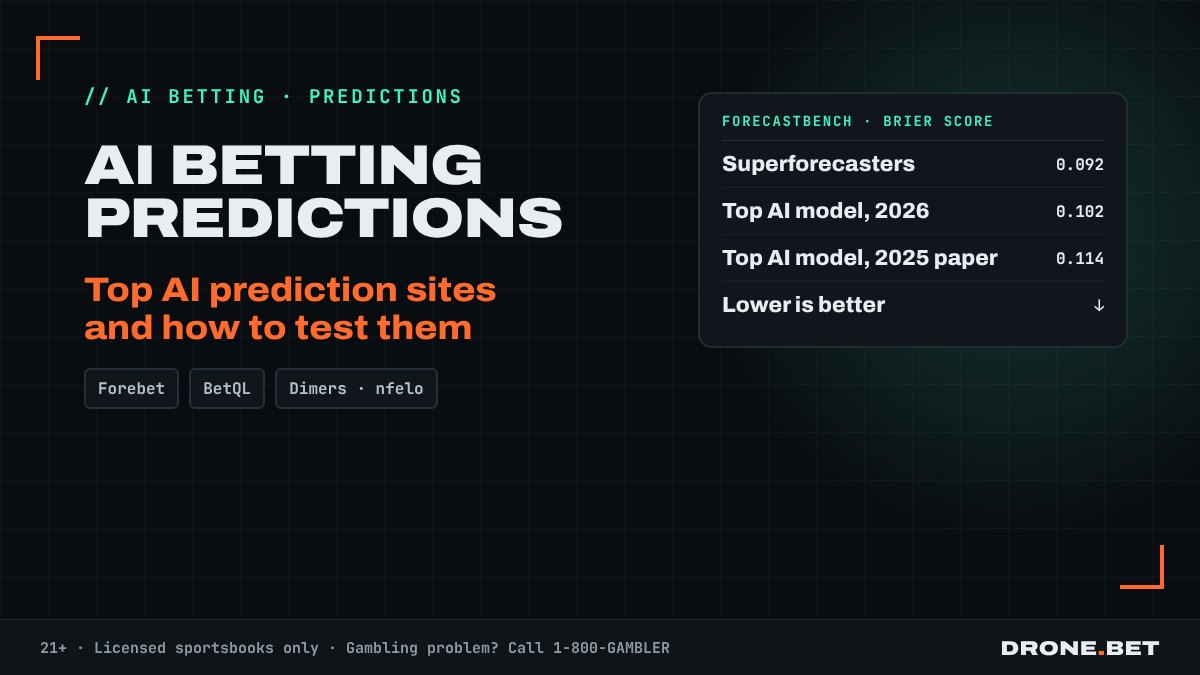
The most rigorous public test of AI forecasting is ForecastBench, run by the Forecasting Research Institute. On its question set, expert superforecasters scored 0.092 against 0.114 for the top AI model, measured by Brier score, where lower is better. The institute’s January 2026 update found the gap narrowing, with the top model at 0.102.
Betting is harder still. In April 2026 the AI lab General Reasoning published KellyBench, which gave 12 leading AI models a simulated £100,000 bankroll to bet through the 2023-24 Premier League season. Every model lost money on average, from −3.7% for Claude Opus 4.7 to −98.8% for Mistral Large. The lesson: AI predictions are a useful input, not a strategy on their own.
AI predictions by sport
- Football (soccer): the deepest free coverage, led by expected-goals models. See our AI football betting tips.
- NFL and college football: Elo and EPA models such as nfelo. See our AI NFL predictions.
- Horse racing: speed figures, form scores and market-blended predictors. See our AI horse racing tools.
- Prediction markets: AI agents and markets on AI itself. See AI prediction markets.
Want to build your own predictions with a chatbot? Our guide to using AI for sports betting covers prompts and a research workflow.
Free vs paid AI prediction sites
Free sites earn money from bookmaker advertising. Remember that when a free tip happens to come with a sign-up link. It does not make the probabilities wrong, but the site profits from your bet, not your win.
Paid tools earn money from subscriptions, so their incentive is to keep you subscribed. The good ones do that with features you can verify, such as odds comparison, closing line tracking and published records. The worst do it with streak screenshots.
| Need | Free option | Paid option |
|---|---|---|
| Soccer probabilities | Forebet | BetQL soccer models |
| NFL baseline | nfelo | Rithmm, BetQL |
| Daily AI picks | Leans.ai free pick | Leans.ai packages |
| Price comparison and +EV | OddsShopper free picks | OddsJam, Outlier Pro, Unabated |
| Prediction market data | Free tiers of independent dashboards | OddsJam Prediction Traders |
How we ranked the AI prediction sites
We weighed each site on five things:
- Transparency: does it explain its method and show its output as probabilities?
- Verifiability: can you check its record, with timestamps and odds?
- Coverage: how many sports, leagues and markets does it reach?
- Pricing clarity: is the price on the page, or hidden behind a sign-up?
- Usefulness for US bettors: does it work with the sportsbooks and exchanges available in legal states?
Accuracy claims were not part of the score, because none of the sites publishes an independent audit. Instead, the next section shows you how to run your own.
How to evaluate AI prediction accuracy
Every prediction site has a hit rate on its homepage. Very few have one that means anything. Six checks sort them out.
1. Ignore win rate on its own
A site picking heavy favorites can claim 75% accuracy and still lose money, because the payouts are small. Accuracy only matters next to the odds available when the pick was made.
2. Score the probabilities, not the picks
Good models output probabilities, and probabilities can be scored. The standard measure is the Brier score: the squared gap between the forecast and what happened (1 or 0), averaged across events. Forecast 70% and the event happens, you score (1 − 0.70)² = 0.09. Forecast 70% and it doesn’t, you score 0.49. Lower is better; always saying 50% scores 0.25.
3. Check calibration
Group a site’s predictions by confidence. Of all the games it called at 60%, roughly 60% should have landed. A model whose 80% calls win 65% of the time is overconfident, and overconfidence costs money when you size bets with Kelly.
4. Compare with the closing line
The market’s final price before kick-off is the toughest benchmark there is. If a site’s picks regularly get better prices than the close, it has information. If they don’t, its winning streak is probably variance. Convert any price with our implied probability calculator.
5. Demand sample size and timestamps
Fifty picks prove nothing. Several hundred, published before the event and never edited, start to. Be suspicious of records that reset each season or only show “premium” picks.
6. Price in the vig
At -110, you need to win 52.4% just to break even. A model “right 53% of the time” against the spread is barely profitable after the book’s margin. One at 51% loses money, however clever the AI.
Red flags on AI prediction sites
- Accuracy claims with no odds, sample size or dates attached.
- “Guaranteed”, “lock” or “fixed match” language.
- Records shown only as screenshots of winning slips.
- Pay-per-pick upsells pushed through Telegram or WhatsApp.
- No explanation of what data the model uses.
A real model can tell you what it thinks and how sure it is. A scam can only tell you it wins.
A simple routine for using AI predictions
- Pick one or two sites whose method you understand, rather than collecting tips from ten.
- Write down each prediction’s probability and the top available price before the event.
- Bet only when the model’s probability beats the no-vig market price by a clear margin.
- Stake a small, consistent share of your bankroll; our Kelly criterion calculator gives a ceiling, not a target.
- Review the log every month against the closing line, and drop any source that is not beating it.
It is unglamorous, but it is the same discipline the professional tools are built around.
21+ for sports betting; prediction market age limits vary by platform. Gambling problem? Call 1-800-GAMBLER.
FAQ
Which AI prediction site is the most accurate?
None publishes an independently audited long-term record, so nobody can fairly name a single winner. The fairest test is to log a site's probabilities against the closing odds and score them with a Brier score over several hundred events.
Are AI sports prediction sites free?
Many are. Forebet, nfelo and the free tiers of OddsShopper and Leans.ai cost nothing. Paid services such as BetQL, Rithmm and OddsJam add model detail, alerts and price comparison.
Can AI predict Polymarket or Kalshi markets?
AI tools can summarize news, track large traders and spot price gaps between Polymarket, Kalshi and other venues. They cannot know the outcome. Prediction market prices already reflect what traders know, so any edge tends to be small and short-lived.
What is a good accuracy rate for sports predictions?
It depends on the odds. Picking favorites can produce a high hit rate and still lose money. At standard -110 pricing, a bettor must win more than 52.4% of bets to break even, so a sustained 55% against the spread would be strong.
How do AI sports predictions work?
A model learns from past results and inputs such as team ratings, expected goals, injuries, rest and weather, then outputs a probability for each outcome. Comparing that probability with the bookmaker's price, after removing the margin, shows whether a bet has value.
Are AI predictions better than bookmaker odds?
Usually not. Closing odds at major sportsbooks are among the most accurate forecasts available, because they combine many models and sharp money. AI predictions are most useful in markets bookmakers price less carefully, such as lower leagues and player props.
Are AI forecasts better than human experts?
Not yet, on the main public benchmark. In ForecastBench, run by the Forecasting Research Institute, expert superforecasters scored 0.092 against 0.114 for the top AI model (lower is better). Its January 2026 update found the gap narrowing, with the top model at 0.102.