






// Ranked
AI NFL Predictions and College Football AI Picks: How the Models Work
How AI NFL predictions and college football AI picks are made, the tools that publish them, where spreads, totals and props hold up, and how to judge a model's record against the spread.
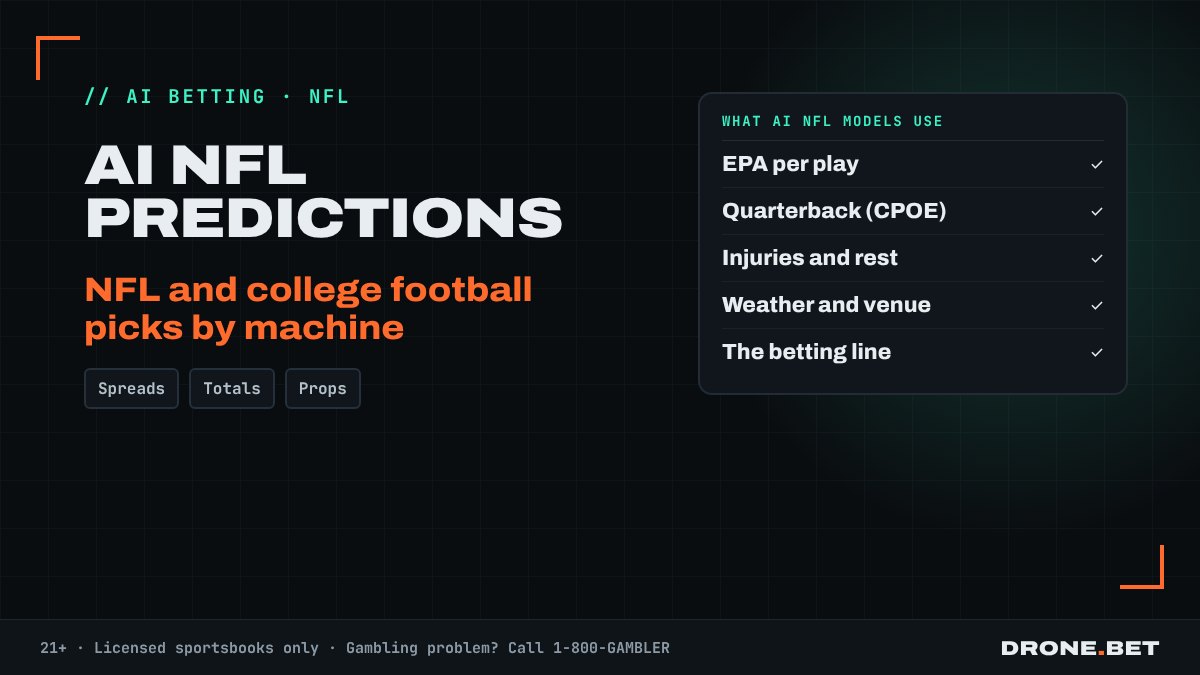
AI NFL predictions have gone mainstream. Sports media publish weekly “AI picks” tables, sportsbooks such as FanDuel now have AI assistants in their apps, and subscription models rate every spread and total. Most of them rest on the same core: a team rating, a quarterback adjustment and a comparison with the betting line.
This guide explains how AI football predictions for the NFL and college football are made, which tools publish them, where spreads, totals and props hold up, and how to judge a model’s record before you trust it. For soccer, see our AI football betting tips.
How AI predicts NFL games
NFL models usually start with a team rating system, most often Elo or a points-per-play efficiency metric. Each result nudges a team’s rating up or down depending on how surprising it was. The model then converts the rating gap between two teams, plus home field, into a projected spread and a win probability.
The quarterback is the biggest single adjustment. Models such as nfelo carry a separate QB rating so that an injury changes the projection immediately, rather than weeks later as results catch up.
The problem is efficiency. NFL sides and totals attract huge volume and sharp money, and closing lines are hard to beat. At standard -110 pricing you need to win 52.4% against the spread to break even. A model must beat a coin flip by a margin few public systems sustain. Use our implied probability calculator to see what any line assumes.
What data AI NFL models use
Public NFL models draw on a fairly standard set of inputs. What separates them is how they weight each one and how quickly they react to news.
- Efficiency per play. Expected points added (EPA) measures how much each play changes a team’s scoring chances. Built from the open nflfastR and nflverse data, it is the backbone of models such as nfelo.
- Quarterback play. Completion percentage over expected (CPOE) and EPA per dropback isolate the passer from the offense around him. A backup quarterback can move a fair spread by several points.
- Injuries and rest. Missing offensive linemen, short weeks after Thursday games and returns from bye weeks all shift projections.
- Weather and venue. Wind, cold and altitude affect totals more than sides.
- The market itself. Many models blend their own number with the betting line, because the line already contains information the model lacks.
Tools that publish AI NFL and college football picks
nfelo
nfelo takes FiveThirtyEight’s Elo rating system and adjusts it for home field, rest, weather and quarterback performance. It is built on the open nflfastR data. It publishes power ratings, game predictions and its model performance, all free. That transparency makes it the clearest baseline for judging any paid NFL pick service.
BetQL
BetQL’s NFL and college football models rate spreads, totals and moneylines from one to five stars and update as lines move. BetQL calls it a computer model rather than AI. Its sharp report shows where professional money sits, which is useful when the model disagrees with the market. Starter costs $6 a month for one sport.
Rithmm
Rithmm lets you weight factors such as offense, defense and situational stats, then track how your custom NFL model performs over the season. Plans start at $29.99 a month on its pricing page, with a seven-day trial.
Leans.ai
Leans.ai’s Remi model publishes NFL and college football picks with a win probability and a confidence rating in units. Leans states that it “does not offer guaranteed winners or guaranteed profits”, and one pick a day is free.
Dimers and Juice Reel
Dimers simulates every NFL and college football game thousands of times and adds Dimebot, an AI chat assistant, for $29.99 a month. Juice Reel runs AI bots trained on synced sportsbook bets that post timestamped NFL and NCAAF picks; its app is rated 4.8 from 4,600 ratings.
FanDuel AceAI
FanDuel’s in-app assistant answers NFL and college football stats and odds questions for all US customers except in Connecticut, drawing on structured data feeds. It does not place bets; only the customer can add a selection to the bet slip.
For the full field, including prop tools like Outlier, see our AI sports betting apps guide.
Spreads, totals and props: where AI NFL picks hold up
Spreads
Point spreads attract the most money and the sharpest bettors, so they are the hardest market for any model. Treat an AI spread pick as a check on your own view, and bet it only when it disagrees with the market by more than a point or two for a reason you can name.
Totals
Totals depend on pace, weather and play-calling, which models capture reasonably well. Wind is the classic case: strong wind cuts passing efficiency, and totals markets do not always move far enough when forecasts change late.
Player props
Props are where models find the most room. Sportsbooks post hundreds of player lines per game and cannot price every one as carefully as the spread. Tools such as Outlier and Rithmm focus here. The catch is lower limits and faster account restrictions for winning players.
Parlays
Stacking AI picks into a parlay multiplies the book’s margin along with the odds. Check what you give up with our parlay calculator.
How to read a weekly AI picks table
Weekly “AI picks” articles share a common layout. Knowing what each column means helps you separate a useful projection from a headline.
- Projected score and margin. The model’s expected result. Compare the margin with the spread, not the winner with the favorite.
- Win probability. Convert it to fair odds and set it against the moneyline. Our implied probability calculator does both directions.
- ATS and total picks. These are only as good as the line they were made against. A pick posted against -3 may be a different bet at -3.5.
- Season record. Check whether it is against the spread or straight up, at what price, and whether every game counts or only “featured” picks.
If a table gives picks without probabilities or a record, treat it as content, not a model.
Super Bowl and playoff AI forecasts
Futures markets such as the Super Bowl winner or division titles are priced from season simulations. A model plays out the remaining schedule thousands of times using its team ratings and counts how often each team reaches the playoffs or wins it all. Unabated publishes NFL season and player-prop simulators, and Dimers runs thousands of simulations per game.
Two cautions apply. Futures carry bigger margins than weekly sides, so a model needs a larger edge to justify a bet. And your money is tied up for months, which matters if you would rather use it each week.
College football AI predictions: why 130-plus teams change the math
College football is a different animal from the NFL. More than a hundred top-division teams, huge talent gaps and frequent roster turnover make markets thinner and lines softer, especially in smaller conferences. That suits models, which rate every team consistently. It punishes bettors who rely on name recognition. BetQL, Rithmm and Leans.ai all cover college football.
The flip side is that betting limits are lower and books move quickly when sharp money arrives. Some states also restrict college betting: Ohio, for example, banned player props on college games in 2024. Check our Ohio betting guide or your own state’s page before you bet.
Free vs paid NFL models
Free prediction sites are usually funded by sportsbook advertising, so they make money when you sign up and bet, whatever happens next. Paid NFL tools make money when you keep subscribing. Neither model is sinister, but both explain why no site leads with its losing months.
Our advice is simple. Start free, log every prediction you would have bet for a few weeks, and pay only if the record holds up against the closing price. A seven-day trial rarely separates skill from luck, so use it to learn the interface, not to judge results.
Judging an AI pick record against the spread
- Record the price. Log each prediction with the odds available at the time and the closing odds.
- Score probabilities. If the model gives percentages, use a Brier score (the average squared gap between forecast and result) rather than a hit rate.
- Check calibration by band. Its 60% calls should win about 60% of the time.
- Beat the close. A model whose picks consistently move in its favor before kick-off is finding information.
- Size carefully. Even a good model has error, which is why most bettors stake a fraction of full Kelly. Try our Kelly criterion calculator.
For how to judge AI prediction sites across every sport, see our guide to AI betting predictions. To find a legal sportsbook for NFL or soccer, check your state in our US betting guide.
Looking for soccer?
Soccer models work differently: they forecast low-scoring matches where a draw is a real outcome, usually from expected goals. Our AI football betting tips cover the Premier League, La Liga and the Champions League, and our guide to using AI for sports betting shows how to research a game with a chatbot.
21+ only. Bet with licensed sportsbooks in states where online betting is legal. Gambling problem? Call 1-800-GAMBLER.
FAQ
Can AI predict NFL games?
AI models can estimate a fair spread and win probability from team ratings, quarterback play, injuries, rest and weather. They cannot predict results with certainty, and NFL closing lines are among the most efficient prices in sport, so few public models beat them consistently.
How accurate are AI NFL picks?
Judge them against the spread at the price taken. At standard -110 pricing a model must win more than 52.4% of its bets just to break even, so a sustained 55% would be strong. Ask for a full, timestamped record over several hundred picks.
Can AI predict NFL games against the spread?
Models can estimate a fair spread, but NFL lines are among the most efficient markets in sport. Beating -110 pricing requires winning more than 52.4% of bets, and few public models sustain that over several seasons.
What AI tools give college football picks?
BetQL, Rithmm, Leans.ai, Dimers and Juice Reel all publish college football picks or projections. Rithmm lets you build your own model, and FanDuel's AceAI assistant answers college football stats questions inside the FanDuel app.
Are AI college football picks free?
Some are. Leans.ai publishes a free daily pick, and nfelo offers a free NFL model, but most college football models sit behind a subscription, from $6 a month at BetQL to $29.99 at Rithmm and Dimers.
Looking for soccer predictions?
Our AI football betting tips guide covers the Premier League, La Liga and the Champions League, with expected goals models and the markets where they work best.