







// Betting Technology
Two Computers, One Bet: The AI Arms Race in Sports Betting
One computer searches for odds mistakes. Another tries to eliminate them. Both are getting faster and more intelligent, and increasingly, they’re reacting to each other. It’s becoming a game of chess between algorithms, except one side also controls the chessboard.
Imagine two computers watching the same basketball game. The first belongs to a bettor, analyzing live statistics, comparing sportsbook prices and looking for odds that don’t quite add up. The second belongs to a bookmaker, monitoring the same game, calculating probabilities and continuously adjusting its prices as new information arrives.
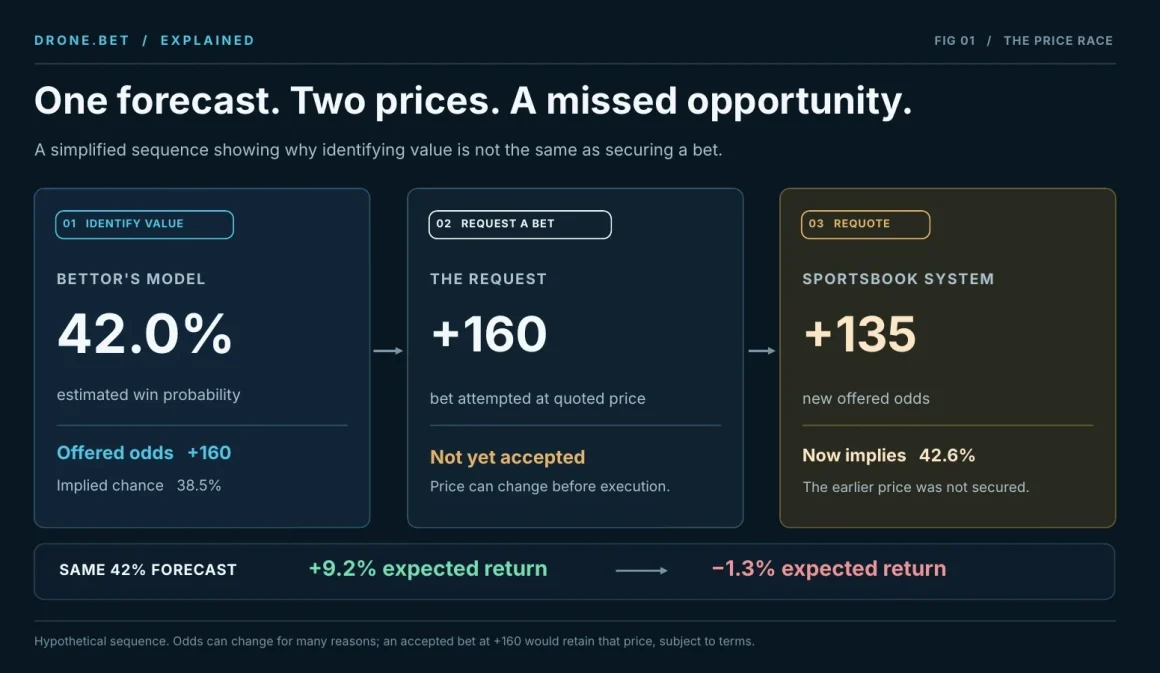
The bettor’s computer spots an opportunity. One sportsbook offers +160 on a team its model believes has a much better chance of winning than those odds suggest. The software flags the opportunity, but by the time the bettor attempts to place the wager, the bookmaker’s system has already shortened the odds from +160 to +135. What looked like an attractive bet a moment ago suddenly isn’t worth taking.
Perhaps the bookmaker’s algorithm spotted something the bettor’s model missed, or perhaps incoming betting activity prompted it to reconsider its prices. Either way, the opportunity disappeared without either computer needing to predict the basketball game’s actual result.
This scenario is hypothetical, but the underlying technology already operates in modern sportsbooks. Bookmakers and professional betting syndicates have used automated trading systems for years, although increasingly sophisticated AI is changing how quickly those systems can process information and respond to one another.
The interesting question is no longer simply whether AI can predict sporting results. It’s what happens when the bookmaker’s AI starts anticipating the bettor’s AI, and both get better at their jobs.
Kambi has already built part of this system
On November 4, 2026, sportsbook technology supplier Kambi published figures that offer a useful glimpse into how far automated betting markets have come.
According to its third-quarter results, approximately 85% of bets across Kambi’s network are now traded through its AI-powered system. That doesn’t mean 85% of all sports betting worldwide, but it represents a substantial amount of activity handled by a major sportsbook technology provider serving more than 70 partners.
The company also reported that 59% of live bets traded through its AI system are now accepted without a built-in delay. Anyone who regularly bets during matches will recognize the familiar processing screen, where the bookmaker takes several seconds to determine whether a wager can be accepted. Sometimes the odds change while you’re waiting, and occasionally the bet is rejected altogether.
Kambi’s technology attempts to remove unnecessary waiting by assessing each wager individually. Instead of applying the same fixed delay to every live bet, the system considers factors such as the current match situation, the wager’s characteristics, and its confidence in the risk assessment. If it determines a bet can be accepted without the usual delay, it can process it faster.
Kambi estimates that these improvements could result in approximately 18 million additional accepted bets annually. That’s clearly beneficial to the bookmaker, which can accept more business, but it also makes the experience more convenient for customers who are understandably frustrated when their bets are rejected after several seconds of processing.
What makes the announcement particularly interesting, however, is that Kambi explicitly identifies AI betting agents searching for pricing inefficiencies as a challenge its technology is designed to counter.
The company describes how its system can respond to incoming wagers by updating its assessment of a match and immediately repricing related markets. Rather than simply displaying odds and waiting for someone to accept them, the bookmaker’s algorithm can use new information, including betting activity, to reconsider what those odds should be.
That introduces a fascinating dynamic. The bettor’s algorithm searches for a mistake in the bookmaker’s pricing, while the bookmaker’s algorithm constantly evaluates whether its prices remain accurate, potentially reacting to the very wagers trying to exploit them.
Source: Kambi Group, Q3 2026 report, November 4, 2026.
One bet, two algorithms: What actually happens?
Let’s return to our basketball game and put some numbers on the situation.
Suppose the bettor’s prediction model estimates that a particular team has a 42% chance of winning. The bookmaker currently offers +160, equivalent to decimal odds of 2.60, which imply a probability of approximately 38.5%.
If the bettor’s estimate is accurate, those odds offer positive expected value. A $100 wager would have an expected profit of approximately $9.20 over many comparable opportunities, assuming the model’s probabilities are reliable.
The betting software identifies the discrepancy and flags the opportunity. Meanwhile, the bookmaker is processing new information about the match, including changes in the game and incoming betting activity. Its trading system reassesses the market and shortens the offered odds from +160 to +135.
At the new price, the same 42% probability produces a slightly negative expected return of approximately 1.3%. The bettor’s model hasn’t changed its prediction, and the basketball team’s actual chances haven’t necessarily changed either. What has changed is the price available to the bettor, turning what appeared to be a profitable opportunity into one that no longer makes financial sense.
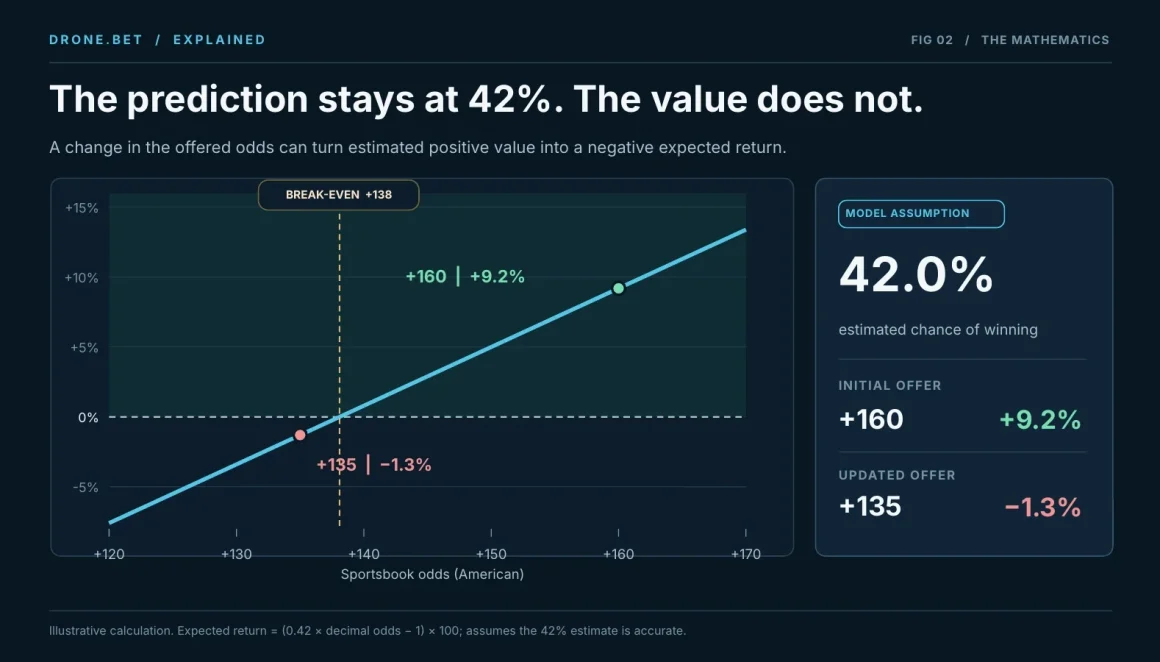
This is an illustrative example, not a recorded Kambi transaction, but it shows an important limitation of automated betting systems. Finding a favorable price and actually obtaining that price are two different challenges, particularly when the bookmaker is constantly updating its markets.
Of course, the interaction could also unfold differently. The bookmaker might accept the original wager at +160 and only then adjust the price to +135, leaving the first bettor with the more favorable odds while subsequent customers receive a different offer. Alternatively, the bookmaker might decide that its original assessment was correct and leave the price unchanged.
The bookmaker’s objective isn’t necessarily to stop every bettor from obtaining a favorable price. It is to manage its overall pricing and exposure as information arrives, which sometimes means accepting a wager and sometimes means changing what it offers next.
This brings us to something interesting about the relationship between the two computers: the bettor’s actions can provide information to the system on the other side.
When your bet teaches the bookmaker something
Bookmakers have always paid attention to where the money comes from. A large wager from an experienced professional bettor may attract more attention than a casual customer placing a small bet, particularly if that bettor has a history of identifying favorable prices.
This practice long predates artificial intelligence. Sportsbook traders have monitored respected bettors and professional syndicates for decades, using their activity as one of several signals when assessing whether a market has been priced correctly.
What’s changing is how quickly these signals can be processed and how widely the resulting adjustments can be applied.
Imagine a sophisticated betting algorithm identifying an attractive price on an NBA team. Its wager is accepted, but the bookmaker’s system recognizes that the activity warrants another look at its underlying probabilities. Adjusting the team’s estimated win probability could also affect the point spread, alternative handicaps, and other related markets.
Kambi describes this automated repricing capability, though the company doesn’t publicly disclose exactly how individual wagers influence its models. A price adjustment might reflect new information about the game, changes in the bookmaker’s financial exposure or a combination of factors rather than anything the bettor’s algorithm has discovered.
Nevertheless, the possibility creates an unusual feedback loop. A betting system identifies an opportunity, places a wager, and may contribute information that helps the bookmaker remove that opportunity for everyone who follows.
This resembles algorithmic trading in financial markets, where sophisticated participants compete over information, execution speed, and small price discrepancies. Sportsbooks operate differently from financial exchanges, but the underlying competition over who recognizes and acts on information first is familiar.
As in financial trading, being right about the underlying value isn’t always enough. The opportunity has to remain available long enough for someone to act on it.
The bookmaker still controls the chessboard
It’s tempting to assume that whichever computer becomes fastest or most accurate will eventually dominate this contest. In reality, the relationship between a bookmaker and its customers makes the outcome considerably more complicated.
A bettor might develop an exceptionally accurate prediction model that identifies outcomes that are regularly mispriced. That would be an impressive technological achievement, but its commercial value would still depend on the available prices and how much the bookmaker is willing to accept.
The bookmaker has considerably more control over those conditions. It determines which markets to offer, adjusts its prices and manages how much exposure it is willing to take, subject to applicable regulations and contractual obligations.
That doesn’t make the bookmaker unbeatable, especially when customers can compare odds across competing sportsbooks or use betting exchanges. But the two sides aren’t competing under identical conditions.
In chess, both players follow the same rules, and neither can change them halfway through because the opponent found a strong move. In sports betting, the bookmaker can change an offered price or decline a proposed wager under its rules, even when the bettor believes the original odds were wrong.
This becomes particularly important as prediction models improve. Suppose both algorithms independently calculate that a basketball team has exactly a 50% chance of winning. If the bookmaker offers -110 on either side, the bettor still faces a margin despite having a perfectly accurate probability estimate.
Predicting the result is therefore only part of the challenge. A profitable betting strategy must identify prices that are better than the estimated probability warrants, and it must find those prices often enough to overcome costs and losses.
Even the most sophisticated AI cannot eliminate that basic requirement.
What happens when computers no longer need us?
For now, many consumer betting tools help people decide rather than deciding entirely on their behalf. They analyze statistics, compare odds and identify potential opportunities, but the customer still decides whether to place the wager.
That division between human and machine could change.
Imagine instructing an AI agent to monitor tonight’s NBA games, compare available prices and identify wagers that meet a predefined expected-value threshold. Instead of repeatedly checking the results yourself, the agent could handle the analysis and keep monitoring the markets as probabilities and prices change.
A more autonomous system might also be authorized to execute wagers within specified limits, provided the operator and applicable regulations allow it.
Meanwhile, the bookmaker’s trading system would evaluate incoming wagers, assess exposure, and adjust prices. The two computers could handle much of the decision-making for individual transactions without a person evaluating each opportunity.
The bettor’s agent might identify a price and submit an order, only to discover that the bookmaker has already changed its offer. It could then recalculate whether the revised odds remain attractive and either proceed or abandon the wager.
Neither computer needs to know which team will win. They care whether the proposed transaction makes sense under their respective models and objectives.
However, important practical limitations remain. Many sportsbooks prohibit automated wagering, including certain forms of robotic betting activity under their terms and conditions. For example, FanDuel’s October 2026 New York rules identify robotically placed wagers as potentially suspicious activity.
Other betting platforms explicitly accommodate automated execution. Betfair’s Exchange API allows approved users to retrieve market information and submit wagers programmatically, although that functionality applies to the betting exchange rather than Betfair’s separate sportsbook.
So fully automated betting is neither an entirely new concept nor something that customers can freely deploy across every sportsbook. The technology already exists in certain environments, while its broader adoption depends on platform rules, regulation and the willingness of operators to provide access.
There are also questions about accountability and consumer protection. A system capable of executing repeated wagers without direct human approval could make financial decisions far more frequently than its owner would ordinarily consider. Spending limits and effective oversight would become particularly important, since removing friction from gambling isn’t necessarily beneficial to the person providing the money.
Still, the technological direction is fascinating. We are approaching a point where humans may increasingly define strategy and financial limits, while software handles much of the analysis and execution.
The bookmaker’s computer decides what price to offer. The bettor has a computer deciding whether that price is attractive. The next development may be systems that can act on those decisions with progressively less human involvement.
What if both algorithms become equally intelligent?
Imagine taking this development another decade, when both bookmakers and bettors have access to exceptionally sophisticated models that can process enormous amounts of sporting information almost instantly.
The systems might analyze injuries, player performance, tactics, historical results and live match conditions with extraordinary accuracy. They could update their probability estimates continuously as new information becomes available, while comparing those estimates against thousands of market prices.
What happens when the two systems become equally good at estimating probabilities?
If both arrive at approximately the same assessment of an outcome, there is relatively little disagreement left to exploit. The bookmaker can continue offering prices that incorporate its commercial margin, while the bettor’s model may struggle to find anything worth taking.
In that scenario, an AI model could become remarkably good at predicting sporting outcomes without identifying many profitable wagers. Its predictions might be accurate, but if the market already reflects those probabilities, accuracy alone doesn’t provide a meaningful advantage.
There’s another complication. If thousands of bettors start using similar AI models, they may identify the same opportunities at roughly the same time. Their collective activity could make those prices disappear faster, making a previously effective strategy less valuable as adoption increases.
In other words, successful betting software could become less useful precisely because too many people are using it.
Of course, there’s no guarantee that the technology will develop into a world where everyone agrees on the probabilities. Sport remains unpredictable, the available data is often incomplete, and even sophisticated models can make poor assumptions. Different algorithms may also reach different conclusions because they weigh information differently or are designed to solve slightly different problems.
The more interesting possibility is that the competition gradually shifts away from who can produce a good prediction and toward who has access to the best information, who receives it first and who can secure the most favorable transaction.
That’s a development worth watching, especially as AI makes analytical capabilities once reserved for professional teams increasingly accessible to individual users.
Could smaller sports become the next battleground?
Most sophisticated betting systems focus heavily on major competitions, where reliable data and substantial betting activity make complex analysis worthwhile.
An NBA game or Premier League match attracts thousands of participants and enormous amounts of statistical information. Pricing mistakes can still occur, but many professional and automated systems monitor the same markets, so they can be identified quickly.
A smaller competition might receive far less attention, raising the possibility that increasingly accessible AI tools could help bettors spot discrepancies in markets professional trading operations have traditionally found less attractive.
Lower-profile esports tournaments and emerging racing competitions are interesting examples, particularly for Drone.bet’s coverage of machine sports and alternative competitions.
But this theory has an obvious problem. Smaller events frequently have less reliable data, lower betting limits and less liquid markets, while bookmakers may compensate for uncertainty with wider margins. A sophisticated model is of limited value if it lacks the information needed to produce reliable predictions, and an apparently attractive opportunity means little if the bookmaker accepts only a negligible stake.
It is therefore possible that AI will make smaller competitions easier to analyze without necessarily making them easier to bet profitably.
Nevertheless, as automated systems become cheaper and more accessible, it will be interesting to see whether sophisticated analysis spreads into competitions that have historically attracted little attention from professional bettors.
And in emerging machine sports, the technology creates an even more unusual possibility.
When the machines are also playing the sport
In January 2026, the Abu Dhabi Autonomous Racing League held a drone championship in which AI-controlled aircraft competed against other autonomous systems and human pilots.
The Human vs AI final was particularly interesting. South Korean FPV champion Minchan Kim faced an autonomous drone developed by TII Racing, and the competition eventually reached a deciding ninth race after both competitors won four times. In the final race, the autonomous drone struck a gate, allowing Kim to take the overall victory.
Elsewhere, TII Racing recorded the fastest autonomous lap, while MAVLAB won the multi-drone racing title. These were real competitions in which autonomous machines made decisions during high-speed flight, not demonstrations of what the technology might eventually achieve.
An interesting parallel exists with automated betting, even though the underlying tasks are quite different.
An autonomous racing drone processes sensor data, estimates its position, and makes continuous decisions about how to navigate the course. A betting algorithm processes sports information and market prices, estimates probabilities, and decides whether a wager represents an opportunity.
Both are examples of machines making complex decisions under uncertainty, though one operates in the physical world while the other evaluates financial risk.
Now imagine what might happen if regulated betting markets eventually develop around autonomous racing competitions. One AI system could control the drone, another could predict the outcome, a bookmaker’s AI could calculate the odds and a bettor’s AI could decide whether those odds were worth taking.
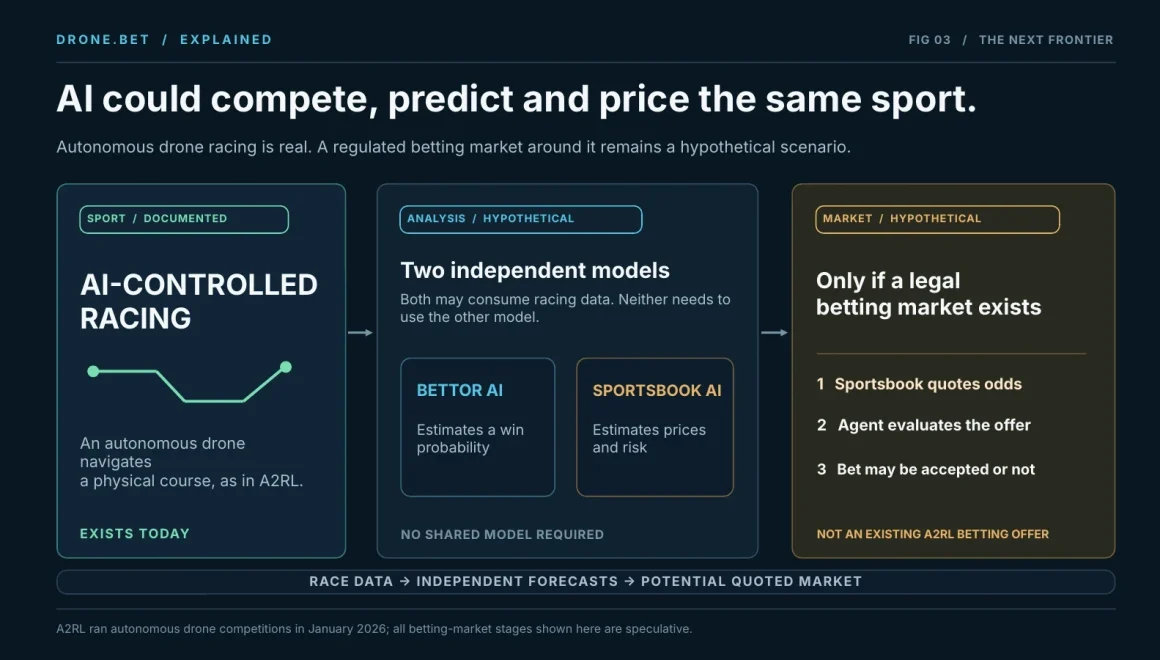
The machines would compete in the sport, predict the result, and potentially trade on the outcome.
There isn’t currently an established, widely available, regulated sportsbook market for these autonomous drone championships, so this remains a possible future development rather than an existing betting product.
But it illustrates how several technological trends could eventually meet. We already have computers competing in sporting events and evaluating sporting probabilities, so combining those activities is no longer particularly difficult to imagine.
For Drone.bet, which follows autonomous racing, machine sports and automated betting technology, this is one of the more intriguing areas to watch.
How would we know which computer is actually better?
A practical problem lies in how betting algorithms are often evaluated.
A prediction service might advertise a high percentage of winning selections, while an odds-scanning platform might demonstrate that it identifies price discrepancies faster than competing products. Both claims can sound impressive without telling us whether customers can actually make money using the technology.
For a bettor’s algorithm, a meaningful assessment needs to consider the prices identified, whether those prices were obtainable, the amount accepted and the results over a sufficiently large sample. A model that regularly identifies favorable odds but cannot execute at those prices may have little practical value.
Closing-line value is another useful measurement because it can indicate whether a model regularly identifies prices before the broader market adjusts. However, even that metric requires caution, particularly when large automated wagers may themselves influence the price used as the benchmark.
The bookmaker measures success differently. It wants accurate pricing, effective risk management, suitable trading margins and a system that accepts as much appropriate betting activity as possible without taking unnecessary exposure.
Kambi’s November results offer some evidence of how it measures these operational improvements. The company reported that NBA live-bet rejections fell about 32% after the sport moved to its AI trading system, compared with the previous year.
That represents an improvement in the betting experience, although it is a company-reported result rather than an independent assessment of customer outcomes.
This distinction is important because faster betting and more accurate prices aren’t necessarily bad for customers. Nobody benefits from unnecessarily slow processing or a bet being rejected simply because a system cannot evaluate it efficiently, and competition between sportsbooks could potentially pass some operational benefits on through better prices or wider market availability.
But convenience shouldn’t be confused with profitability. To determine whether customers are financially better off, we would need more information about the odds they actually receive, the wagers they can place and their long-term results.
Those details are hard to observe from outside the bookmaker’s trading operation, which is why the impact of AI on ordinary bettors remains harder to establish than its operational benefits.
The game might never end
Something about the direction sports betting is taking feels unusual.
For decades, bookmakers employed traders to study events and determine the odds, while bettors analyzed the same information in the hope of identifying something the bookmaker had overlooked. Computers sped up both activities, and increasingly sophisticated AI is making more of the process automatic.
The bookmaker can adjust prices as new information arrives, while the bettor can use software to scan thousands of markets and identify potential opportunities. Each improvement creates an incentive for the other side to become faster, more accurate or better at anticipating what its competitors might do.
That doesn’t mean the computers will eventually eliminate uncertainty from sport, or that bookmakers will stop making mistakes. Different systems will keep producing different estimates, and unexpected results will always be part of betting.
What may change is how hard those differences become to exploit, especially when sophisticated algorithms can spot and respond to them in fractions of a second.
Eventually, the machines might become so good at estimating sporting probabilities that finding an attractive price becomes considerably harder than predicting the result itself.
Which brings us back to those two computers watching the basketball game. One is searching for a mistake, while the other is trying to ensure that its prices remain accurate, and both are getting better at recognizing what the other might do next.
The computers are becoming faster, the decisions more automated and the competition increasingly sophisticated. Whether the person providing the money is getting a better deal is a much harder question, especially when the bookmaker still controls so much of the transaction.
It may be a game of chess between algorithms, but unlike an ordinary chess match, the two sides aren’t playing on quite the same terms.
Drone.bet covers AI betting technology, automated systems and machine sports. Betting algorithms cannot guarantee profitable predictions. The hypothetical betting examples in this article are illustrative and do not represent recorded sportsbook transactions. Gambling involves financial risk, and platform rules or applicable laws may restrict automated wagering.
