// Machine Sports
Humanoid Robots Can Outrun Us. Folding Laundry Is Still Hard.
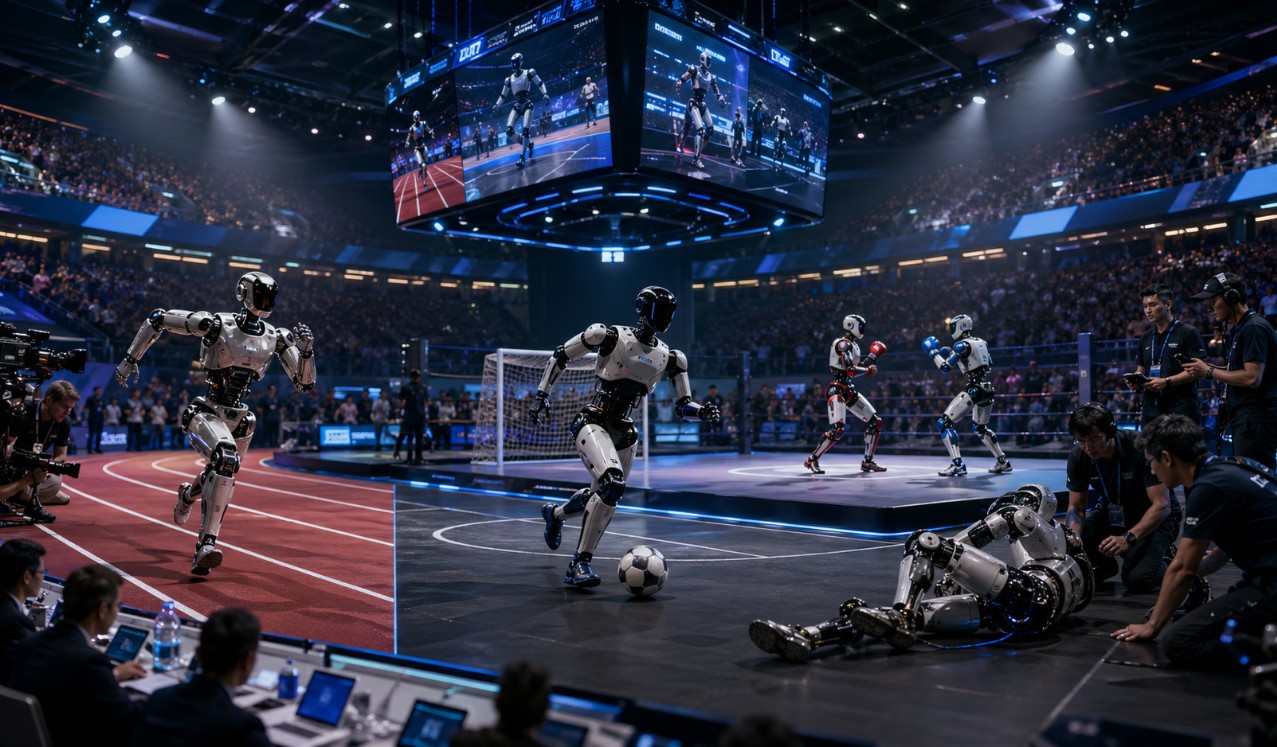
At the 2026 World Humanoid Robot Games, robots ran faster than Usain Bolt and nearly three times faster over 1,500m than a year earlier. None could finish a household routine. What humanoids can actually do.
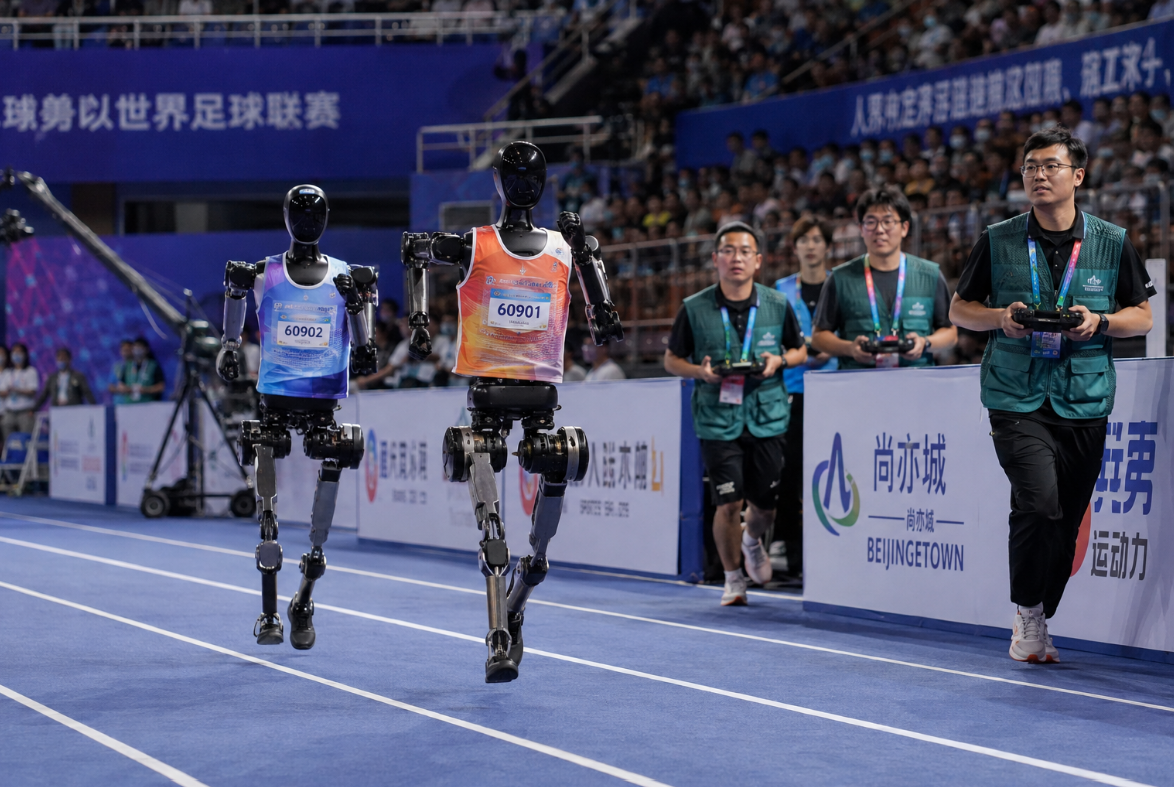
A humanoid robot ran 100m in 8.64 seconds in Beijing in August. Another covered 1,500m in 2:21.64, more than a minute inside the human world record. And in the household event, robots had 30 minutes to tidy a living room, fold clothes and load a washing machine. None got through the list.
That contrast, from the second World Humanoid Robot Games, is the clearest answer yet to what humanoid robots can do. They move brilliantly. They still struggle to handle things.
A robot ran 100m faster than Usain Bolt
In a preliminary heat on August 22, Tiangong Ultra from the Beijing Humanoid Robot Innovation Center ran 9.39 seconds. Honor’s Lightning ran 9.47. Both beat Bolt’s 9.58, according to Reuters reporting in the SCMP. A year earlier Tiangong Ultra won the event in 21.50 seconds. By the final, Tianjiao Team’s robot had taken the large-robot title in 8.64.
The full table is in our World Humanoid Robot Games 2026 results.
Fast doesn’t yet mean fully controlled
Raw speed is mostly a hardware story: motor torque, stride length, a light frame. The harder part is control at speed. Robots that sprint well can still be poor at stopping, turning or reacting to something unexpected. They also run in their own size classes, on surfaces and lanes built for them.
The 1,500m is the more telling number. Organizers cut the time limit from 40 minutes to 15 and required the race to be run autonomously. The winning time dropped from 6:34.40 in 2025 to 2:21.64. Holding balance, managing heat and battery draw over more than two minutes is a real advance.
Tennis may tell us more than running
Before the opening ceremony, Galbot put a humanoid on a tennis court against human players. It traded forehands and backhands, then lost its balance chasing a ball and fell backward. It got up and resumed play, the SCMP reported. Galbot has claimed its robots can sustain more than 100 consecutive autonomous rallies, which is a company claim rather than an independent result.
Tennis is harder than sprinting because the robot has to predict where a ball will be, move to it and swing a racket in one coordinated action. The fall is the useful bit: getting up and carrying on is exactly the kind of recovery a robot needs outside a stadium.
Then we get to the laundry
The 2026 Games had 21 scenario events, up from six, covering household, hotel, industrial and emergency tasks. There were also eight fine-manipulation tests, such as picking up beans and tightening screws.
The household event was set in a smart-home showroom. Robots had 30 minutes for one sequence: tidy a living room, fold clothes and put them away, load laundry, hang clean washing and receive a package. German broadcaster ZDF watched about five hours of the multi-day competition and saw no robot complete the full routine.
Simpler service tasks went better. In the General Service event, many robots arranged nameplates, printed documents and shredded paper autonomously. In Smart Charging Service, they had 30 minutes to unplug, charge and return connectors for three vehicles, per Beijing’s official summary.
Why is laundry so difficult?
- Cloth has no fixed shape. A shirt changes every time it is touched, so the robot cannot plan a grasp from a model.
- Fingers matter. Folding needs pinches, smoothing and regrasping, which most humanoid hands do poorly.
- Errors compound. A routine of five tasks fails if any step fails. A 90% success rate per step gives under 60% for the chain.
- Small details ruin tasks. Beijing’s coverage noted that a wrong spoon angle or pouring speed can spoil a kitchen task.
Autonomy matters more this year
For 2026, organizers required all track and other competitive events to be completed fully autonomously. The 100m and 400m hurdle races were the exceptions, according to the official event preview. Scenario events allowed teleoperation in some cases but scored a remotely operated run at half the weight of an autonomous one.
That matters because many viral humanoid videos are teleoperated. A robot doing chores with a human in a VR headset nearby is a demo of hardware, not intelligence. The same distinction runs through robot combat, where nearly every humanoid fight is still human-piloted.
What humanoid robots can do: a scorecard
| Skill | Where it stands | Evidence from Beijing 2026 |
|---|---|---|
| Sprinting | Very advanced | 8.64s 100m final; sub-9.58 heats |
| Endurance running | Advanced | 2:21.64 1,500m, run autonomously |
| Balance recovery | Improving | Galbot fell and got up mid-rally |
| Simple service tasks | Emerging | Nameplates, printing, shredding done autonomously |
| Fine manipulation | Still difficult | Dedicated bean and screw tests |
| Multi-step household work | Not there yet | No full household routine observed |
The ratings are our editorial judgment based on the results above, not measured scores.
What this means for buyers and investors
If a company shows you a humanoid sprinting, you are watching the solved part of the problem. Ask instead how long it can work autonomously on a multi-step task, how often it needs a human to intervene, and how it handles objects it has never seen. Those are the numbers that decide whether a humanoid can earn its keep in a warehouse, a hotel or a home.
Why the Games are useful
Company demos are edited. The World Humanoid Robot Games are timed, refereed and public, and failures happen on camera. With 2,056 robots from 666 teams registered in 2026, it is the closest thing the industry has to an independent benchmark.
The harder test is whether these skills work together. A robot that can run, balance, see and grip separately is a set of demos. One that can do them in sequence, in a messy room, without a human on a remote, is a product. Beijing showed the first. The second is still ahead.
For forecasters, the gap between speed and dexterity is the kind of milestone question AI prediction markets tend to price. Trading event contracts involves risk of loss.
FAQ
What can humanoid robots do today?
Run, walk and balance very well: at the 2026 World Humanoid Robot Games robots ran 100m in 8.64 seconds and 1,500m in 2:21.64. Simple service tasks such as arranging nameplates, printing and shredding documents are now possible autonomously. Multi-step household work and fine manipulation remain unreliable.
Can humanoid robots do household chores?
Not reliably. In the household competition at the 2026 Beijing Games, robots had 30 minutes to tidy a room, fold and put away clothes, load laundry, hang washing and receive a package. Observers reported no robot completing the full sequence.
Why is folding laundry hard for robots?
Cloth changes shape every time it is touched, so a robot cannot plan a grasp from a fixed model. It needs fine finger control, real-time vision and recovery when the fabric slips, all at once.
Are humanoid robots autonomous?
Increasingly. At the 2026 World Humanoid Robot Games, all track and competitive events except the 100m and 400m hurdle races had to be completed fully autonomously. Scenario events allowed some teleoperation but scored it lower.