// Machine Sports
World Humanoid Robot Games 2026 Results: Robots Run 100m in 8.64 Seconds
Humanoid robots ran 100m in 8.64 seconds and 1,500m in 2:21.64 at the second World Humanoid Robot Games in Beijing. The results, and what they actually prove.
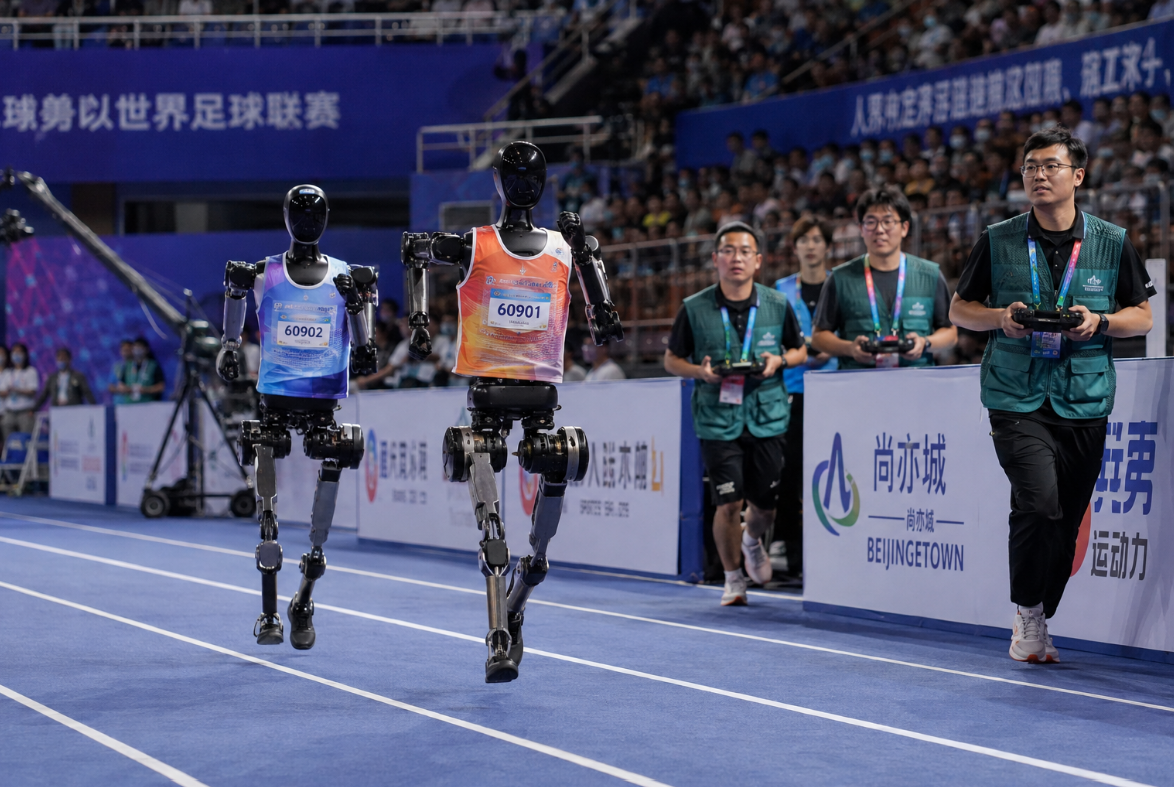
A year ago the winning humanoid needed 21.50 seconds to cover 100m in Beijing. On August 22, 2026, in a preliminary heat, the same robot line, Tiangong Ultra, ran 9.39. Honor’s Lightning did 9.47. Both were faster than Usain Bolt’s 9.58-second world record, which has stood since 2009. By the final, the winning time was 8.64.
The second World Humanoid Robot Games ended on August 26 at Beijing’s National Speed Skating Oval with records in almost every running event. We look at what happened, and what the numbers do and do not prove.
World Humanoid Robot Games 2026 results: track
| Event | Winner | Time | 2025 comparison |
|---|---|---|---|
| 100m, large robots | Tianjiao Team | 8.64s | Tiangong Ultra won in 21.50s |
| 100m, small robots | Tianxiao Team | 11.98s | – |
| 400m, small robots | Tiangong Omni (Beijing Innovation Center of Humanoid Robotics) | 45.66s | – |
| 1,500m | Tianzhuo Team | 2:21.64 | 6:34.40 |
Winners and times are from the Beijing municipal government’s results summary. Several teams also set competition records in other track and field events.
Who built the winners
The Tiangong name runs through the results. Tiangong Ultra and Tiangong Omni both come from the Beijing Humanoid Robot Innovation Center, which has turned the Games into its shop window. Honor, better known for smartphones, brought Lightning. The same robot finished Beijing’s humanoid half-marathon in April 2026 in 50 minutes 26 seconds, against a 2025 winning time of 2 hours 40 minutes 42 seconds. A phone maker building a sprinting robot tells you how many Chinese tech companies now see humanoids as their next product line.
The sub-Bolt heats
The heats on August 22 produced the photos that went around the world. According to Reuters reporting carried by the South China Morning Post:
- Tiangong Ultra: 9.39 seconds.
- Lightning (Honor): 9.47 seconds.
- A Unitree Robotics entry: 12.41 seconds, last in the heat.
One caveat matters. Robot times are not human times. Robots compete in their own size classes on their own rules, and nothing here is ratified by World Athletics. Comparing 8.64 to 9.58 is a headline, not a sporting result.
The 1,500m is the bigger story
Sprinting rewards motors and stride. Middle distance tests what the industry has struggled with: thermal management, battery draw and staying balanced for nearly 150 seconds without a stumble. Tianzhuo Team’s 2:21.64 is almost three times faster than the 2025 winning time and comfortably inside the human world record of 3:26. Organizers also cut the 1,500m time limit from 40 minutes to 15 for 2026.
Beyond the track: scenario events
The Games had 21 scenario events in 2026, up from six. These test the jobs humanoid makers are actually trying to sell:
- Smart Charging Service: 30 minutes to unplug, charge and return connectors for three vehicles.
- General Service: many robots autonomously arranged nameplates, printed documents and shredded paper.
- Fine manipulation: eight tests, including picking up beans and tightening screws.
Scenario events allowed some remote operation, but organizers weighted fully autonomous performances more heavily. Our piece on what humanoid robots can actually do goes through why household tasks remain far harder than running.
Tennis, and a fall
Before the opening ceremony, Beijing’s Galbot showed off a humanoid trading forehands and backhands with human players. It lost balance chasing a ball, fell backward, got up and carried on, as the SCMP reported. Balance, limited autonomy and battery life are still the weak points.
The medal schedule
Beijing’s preview set out how the five days were structured. Opening night on August 22 featured a 7-a-side soccer exhibition plus the 100m and 400m preliminaries. Twelve gold medals were decided on August 23. Weightlifting awarded two golds, lightweight and heavyweight, on August 24. The freestyle fighting finals and the 5-a-side soccer final closed out the competition before the closing ceremony on August 26.
Preliminary rounds were removed for 2026, and time limits were cut hard. The 100m limit fell to one minute (from three) and the 400m to five (from 15). The 1,500m limit dropped to 15 minutes (from 40). A robot that could not finish fast was simply out.
Off the field: robots selling robots
The Games are also a retail event. More than 100 robot-themed products launched, and the on-site store sold over 200,000 yuan of merchandise on opening day. A leisure market in the Ice Ribbon complex had 70 stalls, 28 of them staffed by robot vendors. Champion robots were expected to make pop-up appearances in Beijing neighborhoods afterward.
The numbers behind the 2026 Games
| Metric | 2026 |
|---|---|
| Teams | 666 from 16 countries |
| Robots registered | 2,056 |
| Events | 51 (30 competitive, 21 scenario) |
| Competition sessions | 1,301 |
| Referees | 223 |
| Ticket prices | From 98 yuan (competition days) |
For background on formats, rules and how the event started, see our World Humanoid Robot Games explainer.
What the 2026 results prove
Three things. Locomotion is close to solved for straight-line running on a flat track. Autonomy rules are now strict enough that most results reflect the robot’s own software. And manipulation, not speed, is where the gap to useful work remains.
For investors, that is the line between a viral clip and a product. For sports fans, the next step is head-to-head formats such as fighting and soccer under the same autonomy rules. Our robot combat sports hub tracks them.
Can you bet on robot athletics?
No. No US state-regulated or UK-licensed sportsbook lists markets on the Games. Regulated prediction markets list contracts on AI and technology questions, which is the nearest legal option for forecasting this space. Trading event contracts involves risk of loss.
FAQ
What was the fastest 100m at the World Humanoid Robot Games 2026?
Tianjiao Team's robot won the large-robot 100m title in 8.64 seconds. In the heats, Tiangong Ultra ran 9.39 seconds and Honor's Lightning 9.47 seconds, both faster than Usain Bolt's 9.58-second world record.
Did a robot beat Usain Bolt's record?
Yes, on time. Several humanoid robots ran 100m faster than Bolt's 9.58 seconds in Beijing in August 2026. The robots run in their own categories and the times are not comparable to human records under World Athletics rules.
Who won the 1,500m at the World Humanoid Robot Games 2026?
Tianzhuo Team won in 2 minutes 21.64 seconds, down from the 6:34.40 winning time in 2025 and faster than the human world record of 3:26.
How many robots competed in 2026?
2,056 robots from 666 teams in 16 countries were registered for 51 events at the National Speed Skating Oval in Beijing on August 22–26, 2026.