// Commercial Drones
The $59,000 Personal Drone Is Real. But Where Can You Actually Fly It?
An Idaho agricultural drone company is selling a single-seat electric VTOL for $59,000 that, in the US, you can legally fly without a pilot license. Where you are allowed to take it is another matter.
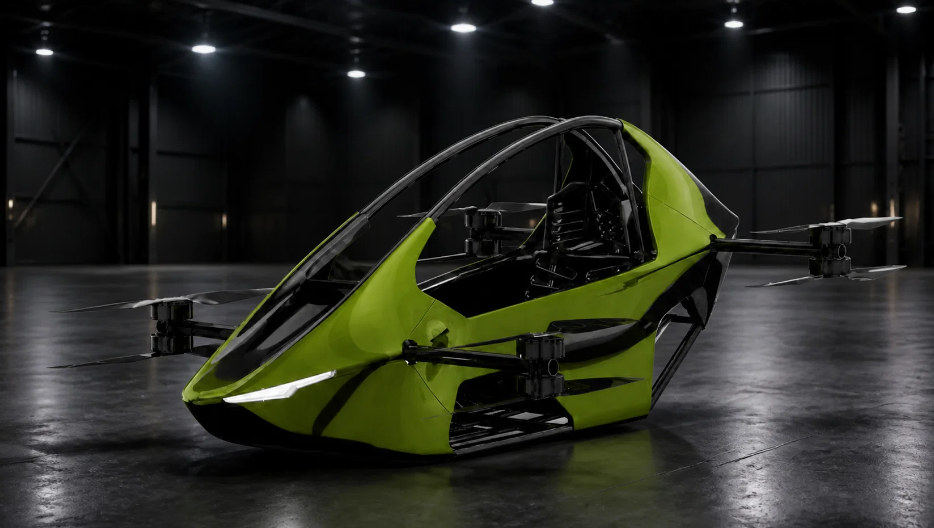
For $59,000 an Idaho company will sell you a single-seat electric aircraft with eight rotors that takes off vertically. Under US rules, it needs no pilot license to fly. It is a real product with a real showroom. It is also, for most buyers, an expensive way to hover over a field.
The aircraft is the DSP 70 from Drone Spray Pro, a company better known for agricultural spraying drones. We look at what it is, what the rules allow and how it compares with rivals.
What is the DSP 70?
The DSP 70, sold as the Yivtol BASIC, is a single-seat electric VTOL (vertical take-off and landing) aircraft. Eight electric motors provide lift. Buyers visit Drone Spray Pro’s facility in Rexburg, Idaho, where they can sit in the cockpit and watch demonstration flights. Aircraft not in stock are built in about 30 to 60 days after a deposit.
Drone Spray Pro DSP 70 specs (manufacturer figures)
| Spec | Claimed figure |
|---|---|
| Price | From $59,000 |
| Seats | 1 |
| Motors | 8 electric |
| Maximum payload | 198 lb |
| Flight time | Up to about 30 minutes |
| Maximum range | 21.7 miles |
| Top speed | 43.5 mph |
| Batteries | Dual |
| Safety package | Parachute and airbags, +$20,000 |
Those are seller claims, not independent tests. The safety package is optional, which makes the effective starting price $79,000 before freight. Drone Spray Pro also lists larger models, the DSP 80 at $79,000 and the four-battery DSP 100 at $118,999. Our guide to personal drones for sale compares the full range.
Is it really a drone?
Marketing calls it a personal drone. In regulatory terms, a person on board makes it an aircraft, and in the US the relevant category is the ultralight. That is very different from the commercial drones flown under Part 107, which have no one on board.
Do you really need no pilot license?
Under FAA Part 103, operators of qualifying ultralights need no pilot certificate, and the aircraft needs no registration or airworthiness certificate. To qualify, a powered ultralight must:
- carry one occupant and be used for recreation or sport only;
- weigh less than 254 lb empty, excluding certain safety equipment;
- be capable of no more than 55 knots at full power in level flight;
- stay within Part 103’s other performance limits.
There is no FAA knowledge test, minimum age or experience requirement for ultralight operators.
The catch is where you can fly
Part 103 is permissive about who flies and strict about where:
- No flights over congested areas of cities, towns or settlements, or over open-air assemblies of people.
- Daylight only, from sunrise to sunset, with limited twilight exceptions.
- Prior ATC authorization for Class A, B, C or D airspace, and some Class E airport areas.
- Visual reference with the surface at all times.
Put together, that rules out commuting. A personal VTOL is for rural land, private property and open countryside, not the school run.
And you probably shouldn’t fly one untrained
No license does not mean no skill. Drone Spray Pro’s sales process includes training and tethered demonstration flights when conditions allow. Rivals go further: Pivotal requires buyers to complete its own flight training.
The DSP 70 is no longer alone
| Aircraft | Price | Status (Aug 2026) |
|---|---|---|
| Drone Spray Pro DSP 70 | $59,000 | Offered; built to order |
| Jetson ONE | $148,000 | 2026–27 sold out; new orders for 2028 |
| Pivotal Helix | From $190,000 | Designed around Part 103; delivery positions offered |
| Rictor X4 | $39,900 announced | Announced at CES 2026; deliveries promised from Q2 2026 |
Jetson’s ONE is the best known, with about 20 minutes of flight, a 210 lb pilot limit and a software-limited 63 mph top speed. Rictor’s X4 is the cheapest on paper, though we found little public evidence of customer deliveries as of late August 2026.
The technology may be ahead of the use case
Electric multirotor flight is no longer the hard part. Batteries are. Thirty minutes of claimed endurance, with a reserve, means a practical flight of perhaps 20 minutes. Add Part 103’s limits and these aircraft fit a narrow set of uses: rural property owners, aviation enthusiasts, resorts and private estates.
That looks less like flying cars and more like jet skis. It is an expensive recreational vehicle with a strong novelty factor and a defined place to use it.
What to ask before you pay a deposit
- Is the aircraft in stock? If not, get the 30-to-60-day build window in writing.
- Does my configuration stay within Part 103? Optional extras add weight, and the empty-weight limit is strict.
- What training is included? Ask how many tethered and free flights you get before you fly alone.
- Where will I fly it? Check the airspace around your land before you buy, not after.
- Who services it? An eight-motor electric aircraft needs batteries, motors and controllers maintained by someone who knows them.
- What does insurance cost? Get a quote early; it may change the math on the $20,000 safety package.
Who should actually buy one?
A personal VTOL makes most sense for someone who already owns open land away from towns and has the budget for an expensive toy. It suits a buyer who wants the experience of flight without years of training. For anyone else, a few test flights, or a ride on a commercial flight experience, will answer the question for far less money.
So are personal drones finally real?
Yes, with conditions. You can pay a deposit, visit a factory and take delivery of a single-seat electric VTOL in 2026. You cannot fly it over town, at night or very far. The DSP 70 is the most affordable way into a category that is real but restricted, and recreational for now.
For the competitive side of drones, our best racing drones guide and drone racing world cup coverage pick up the story.
FAQ
How much is the Drone Spray Pro DSP 70?
The DSP 70 (sold as the Yivtol BASIC) started at $59,000 as listed in August 2026. The optional parachute and airbag package adds $20,000, taking it to $79,000 before delivery and other costs.
Do you need a pilot license to fly a personal VTOL like the DSP 70?
Not if the aircraft and flight qualify as an ultralight under FAA Part 103, which requires no pilot certificate. Part 103 still limits weight, speed, where and when you can fly, and bars flights over congested areas.
How far can the DSP 70 fly?
Drone Spray Pro claims up to about 30 minutes of flight, a maximum range of 21.7 miles and a top speed of 43.5 mph. These are manufacturer figures, not independent test results.
What are the alternatives to the DSP 70?
The Jetson ONE ($148,000, new orders for 2028 delivery), Pivotal Helix (from $190,000) and Rictor X4 (announced at $39,900) are the main single-seat rivals.